
By Lindsey Munson, managing editor, Plastics Business
“We take the people side to heart, trying to build trust through empathetic actions and mutual respect, which fosters a culture more open to change. From there, we try to build or adjust processes to support what the business needs. No more, no less. That, to me, is lean,” said Bob “Buck” Rodgers, operations manager at Thogus Products.
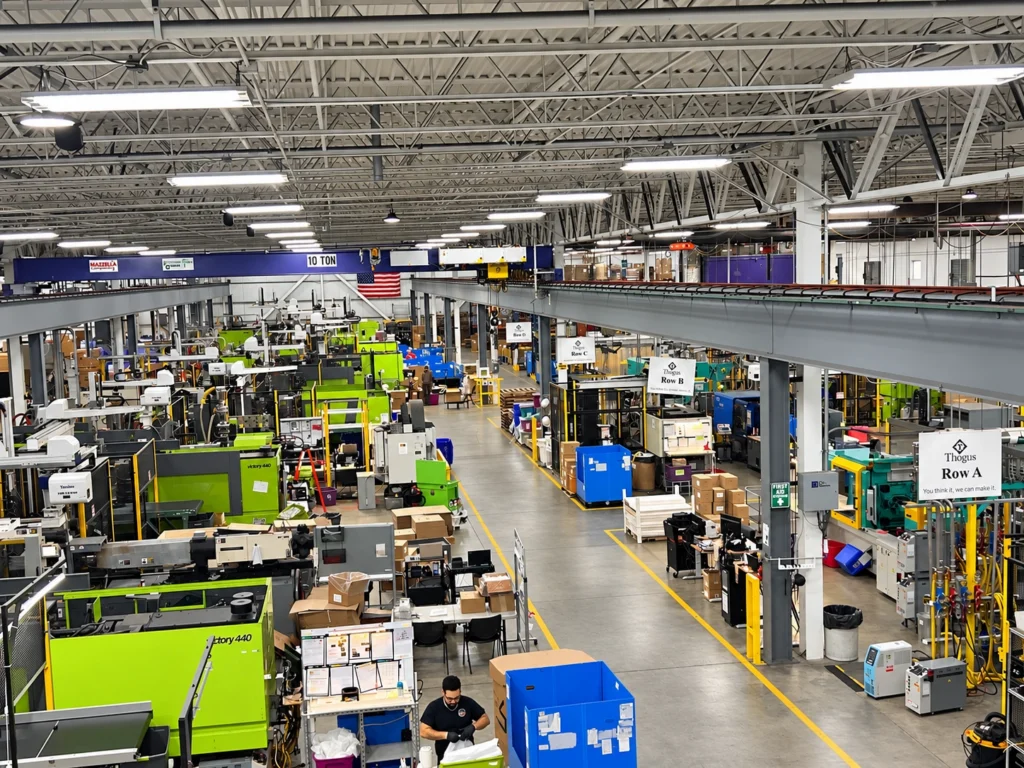
Founded in 1950, Thogus Products is a family-owned custom plastics injection molder and contract manufacturer headquartered in Avon Lake, Ohio. Dedication to building lasting partnerships with customers and supply chain partners has been a cornerstone of the company’s success. Today, as manufacturers face rising costs, labor shortages and customer expectations, operational efficiency is more than an advantage; it’s necessary.
With 30 years of manufacturing experience, including 20 years in leadership, Rodgers has helped guide Thogus’ lean journey. He offers Plastics Business an inside look at how the company has embraced lean manufacturing, proving that meaningful results don’t always come from big changes. Instead, small improvements over time make the biggest impact.
A Lean Culture
For Thogus, lean manufacturing isn’t just on the production floor or a set of tools and practices. It’s become part of the company’s culture, shaping how management communicates with employees, solves problems and identifies opportunities for continuous improvement every day. Rodgers said, “Our philosophy shapes how we manage – leading with inquiry rather than accusation. We ask questions to our employees such as ‘What’s bothering you?,’ ‘What makes your job difficult?’ or ‘What frustrates you?’ Gathering answers to those questions builds leadership capital and, nine times out of 10, supports an initiative the larger data set has us looking at anyway. From there, we identify very specific needs of the business and work on the issues that have maximum impact through guided projects.”
As Thogus has learned over the years, continuous improvement begins with its people. Building trust throughout every department has become the foundation of the company’s lean journey. When asked what cultural changes are most important for lean manufacturing to succeed long term, Rodgers said, “One word: trust. Trust that when employees raise an issue, it is not accompanied by an accusation or discipline. Rather, respect for the past, even if it is wrong, promotes empathy and opens the door to change.”
Within Thogus, that business philosophy is put into practice every day by keeping improvement efforts focused on the lean process rather than the person – looking at the what and where, not the who.
“I find that, in general, people work with very good intentions,” said Rodgers. “It’s our job to ensure those intentions are not wasted.”
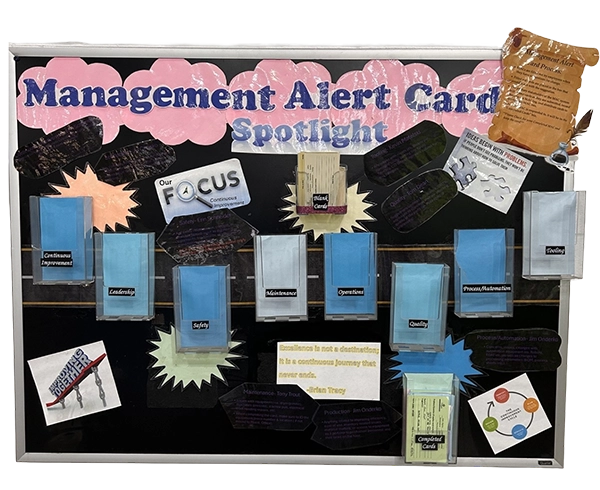
Photo courtesy of Thogus.
Empowering Employees
At Thogus, creating a culture of continuous improvement means giving employees a voice and the opportunity to make an impact. Every team member is encouraged to share challenges, offer solutions and help improve the business – all part of building a long-standing lean mentality.
Rodgers said, “Our most forward-facing process is the Management Alert Card (MAC) process.” The MAC process centers around a dedicated board where employees can pick up a card, document a problem or challenge and propose a solution. Once submitted, management commits to responding to every card within five business days. While some issues can be handled quickly, others require more time and hands-on support through improvement projects. Each month, Thogus posts responses to the cards for the entire company to see, giving employees visibility into the status of their challenges and solutions, reinforcing Thogus’ commitment to continuous improvement.
“We’ve addressed anything from changing to a specific style of gloves to the creation of assembly aids and automation,” said Rodgers. “One of our latest cards addressed an ergonomic condition at a work center where a very tall person was working. We introduced a height-adjustable work surface, typically used in our office environment, for light-duty assembly or staging work on the production floor. These are readily available, inexpensive and have the right durability for the task. With infinite adjustability from 28″-43″, the work center can be tailored to an individual’s height, whether tall or short. It also can move throughout the shop, creating a flexible work environment wherever
it’s needed.”
When asked where lean has had the greatest impact, Thogus had a simple answer: the company’s focus.
Bridging Technology to Lean
Viewed as a tool rather than a replacement for employees, automation and artificial intelligence (AI) have become important topics within the manufacturing industry. Across Thogus’ operations, technology supports lean principles by taking on redundant and non-value-added activities, letting team members use their time and skills on the work that matters most to the company.
Director of Engineering and Quality Jim Onderko offered additional insight. “From a lean standpoint, automation, digital technologies and AI are eliminating non-value-added activities, which speaks to the core principles of lean manufacturing,” said Onderko. “They are helping us reduce or eliminate activity and motion that currently require a human worker’s time, attention and energy. The human worker’s role is being repurposed to another responsibility that provides value to the company. People aren’t being replaced; their time is moving to work that adds value for the company.”
Beyond improving efficiency across operations, technology also is helping employees make better-informed decisions. “We also are seeing improvements in workers’ decision-making skills in terms of speed and scale, because we can quickly analyze large groups of data and focus more on implementation of solutions rather than gathering and organizing critical data,” said Onderko.
Doing the Right Things
While lean has helped Thogus improve efficiency throughout the organization, its leadership said the biggest wins come from staying focused on the work and “the right things” that create the most value. For companies just beginning their lean journey, success doesn’t come from doing big initiatives or going after every opportunity for improvement. Instead, it’s about building employee trust and creating processes that make continuous, daily improvement part of the company’s culture, and that it sticks.
When asked where lean has had the greatest impact, Thogus had a simple answer: the company’s focus.
“It’s not just about doing things well; it’s about doing the right things well,” said Rodgers. “That may sound silly and obvious, but using a lean and continuous improvement mindset forces us to look for improvements where improvements are needed. Call it ‘Pareto the Business.’ Sure, reducing scrap is a great goal, but attaining a scrap reduction on one SKU will not have the same impact as another. We don’t want to be wasting effort to get 20% somewhere when we could have a different goal and get 80% somewhere.”
For plastics processors just beginning their lean journey, Rodgers advised starting small, keeping it simple and focusing on earning employees’ trust. “Avoid the ‘people are the problem’ trap,” he said. I would argue that in most cases, traditional people problems stem from behaviors associated with an errant process, or a lack of process. Keep things process-focused and allow time for the emotions that come with change. Acknowledge the past, why it may not be working now, and work together to fix it for what is needed today. If there still is emotion present, we aren’t ready for the tactical work yet. Take the time.”
Rodgers also encouraged companies to apply the lean concept beyond the production floor.
“Don’t be afraid to subject business practices to lean thinking,” he said. “The losses in front office efficiency don’t show up as well on spreadsheets and Pareto charts. These are the classic ‘that’s the way we’ve always done it’ situations, and unless a process map is developed, they can go undetected.”
When it comes to the long-term value of lean manufacturing, Rodgers believes it comes down to keeping a business relevant to its customers by focusing on what truly matters.
“Lean keeps a business relevant to its customers and does what is needed – no more, no less,” said Rodgers. “It takes a process-focused, people-centric effort. The people part isn’t about what we’re doing wrong; it’s about dealing with the emotions that typically surround change. This prepares our people to do the work of continuous improvement by refining the process.”
More information: www.thogus.com
Three Priorities from Thogus to Build a Lean Culture
- Build Trust
Build trust by sharing information. Explain current conditions, what customers are asking for and where the business isn’t measuring up. Be transparent with employees about the plan, ask for input and keep everyone informed of the progress – both the good news and the challenges. - Pareto the Business
Be specific about the areas that will have the biggest impact. Evaluate where the business has opportunity to improve margins (i.e., SKUs that are leaving value on the table). Keep analyzing priorities because the effort to gain the next 20% in one area may be better spent achieving an 80% improvement somewhere else. Remember, not every opportunity or loss shows up on a spreadsheet; workforce skills and support can be just as important as reducing scrap. - Guide the Process
Set goals and give team members value in ownership of how to achieve them. Don’t be afraid of failure – it is inaction and a loss of trust that one should be afraid of. Monitor progress and keep accountability through regular check-ins and goals.