
By Andrew Carlsgaard, director of benchmarking and analytics, MAPP
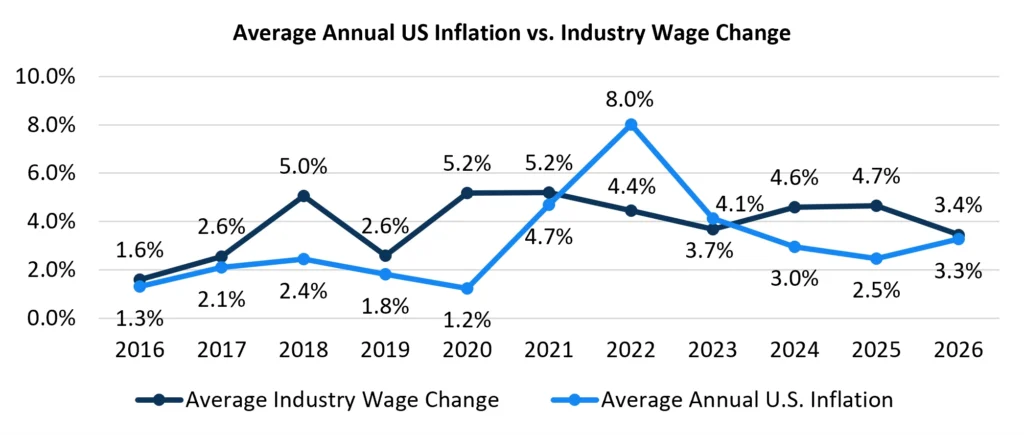
MAPP’s 2026 Wage and Salary Report reflects a labor market that has cooled from the extremes of the immediate post‑COVID period, yet continues to exert meaningful upward pressure on compensation for plastics processors. This year’s findings are based on responses from 190 manufacturing organizations representing approximately 27,000 full‑ and part‑time employees, providing a robust and consistent benchmark set relative to the 196 processors captured in last year’s report. Median wages across all positions in the 2026 survey (Figure 1) rose by 3.4% compared with 2025 rates, a moderation from the 4.7% overall increase reported a year ago, but still notably above the posted wage growth in the broader US labor market, which has decelerated to roughly 2.3% year‑over‑year. 1 At the same time, external data show consumer price inflation 2 running closer to 3.3% on average this year, and US manufacturing compensation costs continuing to rise in the 3.3% range 3, underscoring that plastics processors are operating in an environment where labor costs are more in line with inflation and manufacturing more broadly as demand stabilizes.
Within this overall picture, role‑level results from the MAPP’s 2026 Wage and Salary Report (Figure 2) highlight a continued divergence between certain technical, commercial and leadership positions and more operational roles. Applications engineers posted the largest median salary increase in the survey at 20.7% (though at a relatively small sample size), followed by EHS coordinators/managers (11.3%), plant managers (10.2%), materials managers (9.9%) and customer service directors/managers (9.7%). Many other staff‑level and engineering positions – including TS/QS/ISO coordinators, maintenance directors/managers, information systems managers, manufacturing engineers and sales directors/managers – experienced increases in the 7%-10% range, continuing a multi‑year pattern in which highly skilled or experienced technical and management roles command outsized pay growth.
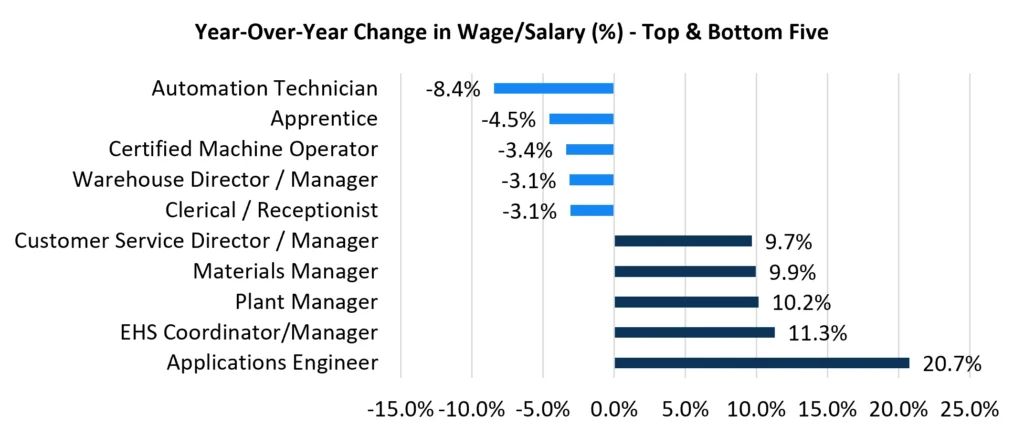
In contrast, several positions saw modest flat or negative movement: Tooling engineers, general managers, administrative/executive assistants, packers, process engineers, marketing directors/managers, technical (semi‑skilled) roles, clerical/receptionist positions, warehouse directors/managers, certified machine operators, apprentices and automation technicians all recorded small declines, with automation technicians experiencing the sharpest drop at ‑8.4%. These mixed results reinforce that wage pressure is no longer uniform across the plant but instead concentrated in roles at the intersection of process reliability, customer service, safety and strategic growth.
As a result, the long‑term trend in management compensation continues to rise. When MAPP examined the combined compensation for nine common staff‑level leadership positions – general manager, engineering manager, human resources manager, information systems manager, maintenance manager, plant manager, purchasing manager, quality manager and sales manager – the median total for a “full plant management staff” rose to $1,055,579 in salary for 2026. This represents a 5.1% increase over 2025 and a remarkable 72.1% increase since MAPP began tracking this metric in 2009, illustrating how strategic and operational leadership has become an increasingly expensive but indispensable resource for plastics processors.
In parallel, recent economic analysis from the Plastics Industry Association 4 highlights that plastics manufacturers should expect continued pressure on non-management roles from minimum wage increases, wage compression and rising benefit costs – especially health insurance – as key drivers of total labor cost growth in 2026.
The experience of MAPP members in this report aligns with that view: Wage growth is moderating but remains structurally elevated from post-pandemic increases and inflation, and leadership teams are more expensive than ever.
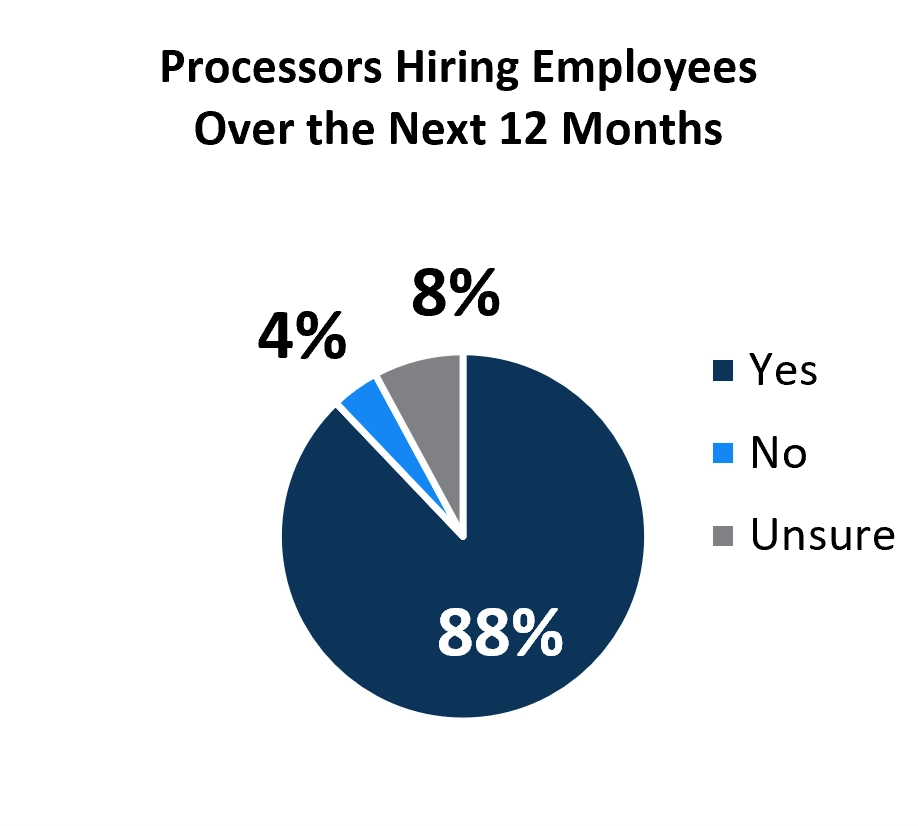
Hiring demand in this year’s survey has firmed slightly relative to the prior report. Back in 2022, 92% of processors indicated they would be actively hiring employees over the subsequent 12 months; by the 2025 report, that figure had declined to 81%. The 2026 survey shows 88% of respondents now planning to hire over the next year, with only 4% stating they will not hire and 8% unsure (Figure 3).
This modest rebound is occurring against a broader backdrop in which the US labor market has shifted into a “low‑hire, low‑fire” steady state: Job postings sit slightly above pre‑pandemic levels, unemployment has drifted up to about 4.3% 5 and job openings per unemployed worker have fallen below one. In other words, competition for talent remains real – especially for specialized roles – but the environment is no longer characterized by the extreme scarcity and rapid wage bidding wars seen earlier in the decade. For plastics processors, this means hiring decisions likely are to be more deliberate and focused, yet the risk of losing critical people remains high where internal pay or total rewards lag market norms.
Benefits data in the 2026 report reinforce the notion that processors are competing on more than just base pay. At least 91% of surveyed companies now offer employee medical insurance, a 401(k) retirement plan, dependent medical insurance, dental care, vision care and employee life insurance, with several key benefits showing modest increases in prevalence compared with 2025.
National benefits data similarly indicate that roughly 91% of manufacturing industry workers now have access to employer‑sponsored healthcare and that benefits represent roughly one‑third of total compensation costs for employers, with insurance, retirement and paid leave standing out as major components. 6 Taken together, these findings suggest that plastics processors continue to lean on comprehensive benefits to support attraction and retention – even as they adjust the mix of offerings to manage cost.
In summary, MAPP’s 2026 Wage and Salary Report shows the plastics industry moving from a phase of rapid, inflation‑driven catch‑up increases into a more measured, differentiated compensation environment. Overall wage growth has moderated, but for many key roles it remains above general posted wage trends; management and select technical roles continue to experience significant upward pressure, and hiring intentions have stabilized at a level indicating ongoing demand for talent.
At the same time, external data and industry analysis highlight that rising benefit costs, minimum wage changes and wage compression will keep total labor costs elevated for plastics manufacturers in 2026 and beyond.
As in prior years, the best practice for leaders is to use the detailed position‑level benchmarks in this report – by revenue range, region and years of service – to calibrate wage and benefit structures, identify where pay may be under‑ or over‑market and proactively address compression and retention risks. Doing so will be essential to maintaining workforce stability and competitiveness in what appears to be a “cooling but costly” labor market.
The entirety of MAPP’s 2026 Wage and Salary Report can be purchased from the MAPP website at www.mappinc.com/resources/benchmarking.
References
- Indeed Hiring Lab: Labor Market Snapshot April 2026
- US Bureau of Labor Statistics – CPI
- US Bureau of Labor Statistics – Manufacturing
- PIA – Rising US Labor Costs: Implications for Plastics Industry for 2026
- Indeed Hiring Lab: Labor Market Snapshot April 2026
- US Bureau of Labor Statistics – Manufacturing