
By Andrew Carlsgaard, analytics director, MAPP
The 2025 MAPP Wage and Salary Report continues to reflect the impact of heightened inflation on wages and salaries across the US workforce. The survey results of 196 manufacturing organizations representing approximately 28,000 employees show an increasingly prevalent upward trend: 65 of the 73 industry job categories (89%) tracked year-over-year have reported increases from 2024 to 2025, up from 57 in the prior year. These increases, as in the preceding years’ reports, primarily are due to the extreme inflation experienced in the previous three years, combined with current-year inflation. Early in the post-COVID-19 era, low unemployment, plentiful job openings and lower participation had created a favorable market
for workers.
However, heightened economic uncertainty, decreased processor capacity utilization and lower worker demand have slowed this trend in the manufacturing industry over the past three years compared to the levels experienced in 2020 and 2021. In addition, unemployment gradually rebounded to pre-pandemic levels in 2022 and has remained consistent since, eliminating the previously favorable market conditions for workers. Inflation – particularly catch-up from the previous three years’ inflation – once again is the dominant factor in wage increases for 2025.
Tracking Key Increases and Reductions
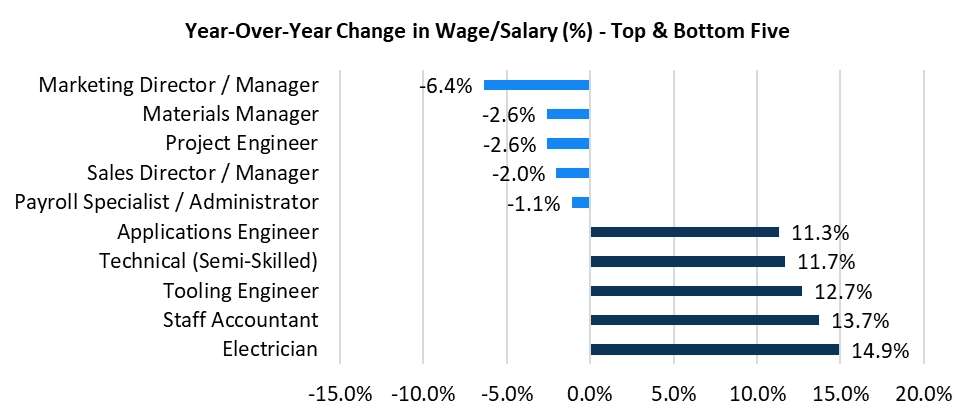
The 2025 MAPP Wage and Salary Report highlights key trends in specific roles within the manufacturing industry. The average annual increase for the 65 positions that saw pay rises was about 5.5%, a slight decline from 6.1% in the 2024 report. Meanwhile, eight positions experienced a decrease in median salary, with rates averaging only 2.1% lower than the prior year (compared to 2.2% lower in the 2024 report). Notably, the largest salary increases were for electricians (a 14.9% rise), accountants (a 13.7% increase) and tooling engineers (a 12.7% increase). Conversely, the most significant median wage reductions were seen in marketing directors and managers (a 6.4% drop, a slight reversal of the nearly 20% increase in the prior survey), materials managers (a 2.6% decline) and project engineers (a 2.6% decline). Overall, while there is no evident pattern in the roles receiving increases, it is worth noting that wages grew by double-digit percentages for many management, finance and engineering positions, perhaps signaling that these support roles currently are in higher demand within manufacturing compared to more operational roles. (Chart 1)
Inflation Influences Wage Growth
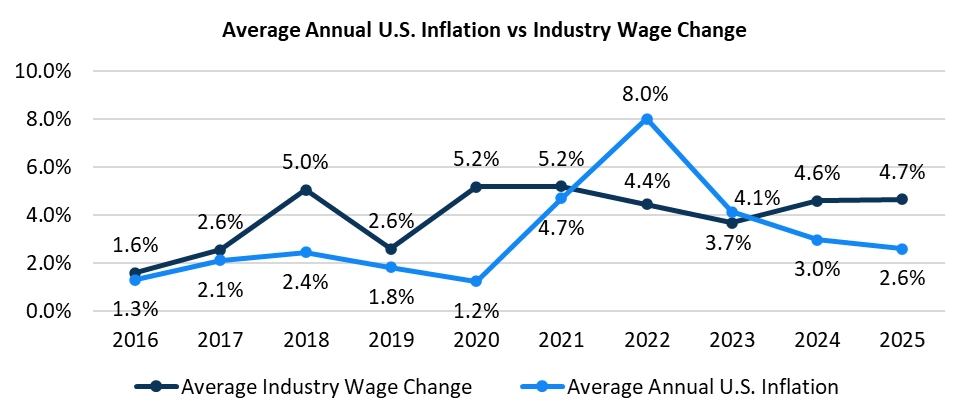
Although the average yearly wage increases for all tracked positions in 2025 have risen from 2024, inflation likely still explains much of this, especially considering the unprecedented inflation level in 2022 (8.0%) that industry wages still are catching up to, as the inflation rate nearly doubled the wage increases that year. The Consumer Price Index 1 (the primary year-over-year price inflation measure tracked by the US Bureau of Labor Statistics) started to surge in early 2021 and peaked in June 2022 at around 9.1%. However, the rate fell to a three-year low of 3.0% in June 2023 and continued to decline to the low 2% range over the past year. As of April 2025, the inflation rate of 2.3% finally has approached the pre-pandemic average of 1.8% in 2019. However, the average annual inflation from January to May 2025 is 2.6%, which only is half of the median wage growth of 4.7% observed across all positions in the 2025 Wage and Salary Report. (Chart 2) Although that wage increase is 1.5 percentage points higher than the previous year (3.9% in 2024), the earlier inflation recovery from the peaks of 2022 remains the main factor driving overall increases, as workers pursue raises or higher salaries elsewhere to offset the nearly double-digit rise in prices of goods and services during
that year.
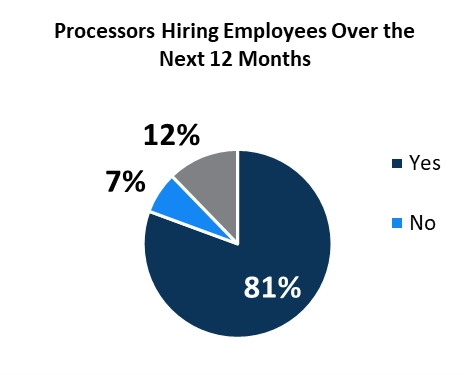
Interestingly, the overall wage increases experienced by respondents were higher than wage increase data tracked by the US Federal Reserve. 2 These reports show yearly wage increases of 4.2% for US manufacturing jobs and 4.5% overall for US jobs. With these elevated year-over-year wage increases, processors report softer hiring demand overall than in recent years. According to the 2022 Wage and Salary Report, 92% of processors said they would be hiring new employees in the next 12 months; however, this percentage has dropped to 81% as of the publication of the 2025 report. (Chart 3) This decrease in labor demand continues to be driven by economic uncertainty, partly due to the current tariff and trade environment, as well as central bank actions aimed at reducing consumer demand and inflation. These factors have impacted manufacturers’ profitability and capacity utilization, leading them to reduce costs and postpone new hiring and investments.
Bottom-Line Impact
Although the survey results may be unfavorable to employers’ bottom lines, the wage and salary increases shown in the 2025 report are expected, given the current economic realities and inflationary pressures affecting workforces nationwide. For manufacturers facing increased pressure on their bottom lines in other areas, such as higher input and general and administrative (G&A) costs, hiring new or backfilled roles at a slower pace than in recent years may become necessary to maintain consistent employment levels and preserve profitability while avoiding future layoffs in the near term. If economic conditions remain favorable for workers, there likely will be some continued upward movement in wages.
However, persistently lower inflation will be essential to curb these elevated annual wage increases that have become common since 2020. Similarly, if the labor market shifts more favorably toward employers during a recession, companies should adjust only to the current market conditions if they align with their immediate business needs.
As a best practice, leaders carefully should review the results for each position in the 2025 Wage and Salary Report and adjust wages accordingly to match industry averages for organizations of similar size or location, thereby staying competitive against peers. Neglecting proper wage adjustments risks losing valuable internal resources and incurring extra costs to replace departing employees. Additionally, knowing the current rates for these positions is crucial for attracting and keeping the talent necessary for steady operations in an uncertain economy.
The entirety of MAPP’s 2025 Wage and Salary Report can be purchased from the MAPP website at www.mappinc.com/resources/benchmarking.
References
US Bureau of Labor Statistics
Federal Reserve Bank of Atlanta