
Press release submitted on behalf of LS Mtron.
Ferris State University and Pittsburg State University students using donated
55-ton LS molding machines
LS Mtron has donated a pair of injection molding machines to Ferris State and Pittsburg State universities to prepare the next generation of the plastics industry workforce.
Ferris State in Big Rapids, Michigan, has received a 55-ton ONE 55E machine that LS Mtron demonstrated at NPE 2024. And Pittsburg State University in Pittsburg, Kansas, is making use of its 55-ton LS ONE 55E in its Plastics Process Laboratory.
Ferris State
At Ferris State University, the LS Mtron ONE 55E was delivered and hooked up in July in advance of students returning to campus for the fall session of the school’s Plastics Engineering Technology program.
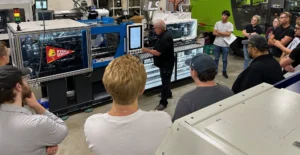
“Our students are going to be really excited to see this machine when they get back to campus next month,” said Tom Van Pernis, associate professor and program coordinator for the school’s Plastics Engineering Technology program. “Our program would not be able to exist without support from industry. We are very grateful for LS Mtron’s support.”
Plastics education at Ferris began around 1968, with the bachelor’s in science program launched in the mid-1980s. The program has graduated more than 1,200 alumni. The program now enrolls about 50 students.
The LS injection molding machine will be used for instruction in Ferris’ Introductory Injection Molding course, which has a six-hour lab. Students begin the semester by looking at machine safeties and identifying machine components, including actuators and position indicators. They progress to setting up clamp action, running short shots and basic process optimization, culminating in a lab final at the end of the semester.
“This machine will be perfect for this class because of its clear guarding,” Van Pernis noted. “We will also use the machine for our Advanced Injection Molding course in the bachelor’s program.” In that course, students perform experiments with engineering-grade materials to better understand how process variables (e.g., mold temperature, injection velocity, hold pressure) affect finished product properties including impact strength, tensile strength, shrinkage, weld line strength and more. “Students also learn and perform various scientific Molding studies.”
Ferris students typically work with a lab partner during the semester on weekly activities but do have an individual lab final for both courses, Van Pernis explained. In the introductory injection molding course, they spend their time learning a basic process setup according to scientific molding principles.
“We load a bogus program that has all critical values set to zero or whatever the minimum value is. They work through first setting up the clamp, then running short shots, and finally progressing to a full part with some process optimization. At the end of the semester they complete a lab final, which is a two-hour individual test where they have to setup a process from scratch and answer questions along the way. Through the semester, the students also learn how to do mold changes, matching molds to machines, basic troubleshooting, identify machine safeties, actuators, and position indicators. As you can imagine, this is a lot of information for the students to digest, and we are very proud of how far they progress in just one semester.”
The advanced molding course has a similar lab final but uses engineering-grade materials and includes more advanced topics such as moisture analysis and velocity profiling. “In this course, we also include any additional technologies the machine might have, such as any kind of AI features, adaptive process features and more.”
Ferris students also learn troubleshooting. “We do not specifically teach maintenance, but the students do have an electrical and a hydraulics course to help understand how the equipment works.”
Because the school’s introductory injection molding course is in the second semester on its checksheet, “students are able to acquire internships and are already be quite proficient on machines,” Van Pernis explained. “The feedback from industry is that our students are quite comfortable on machines and are able to make an impact even after their freshmen year.”
The No. 1 entry-level position that Ferris graduates land is process engineer, he added. “Having support from industry through consignment agreements means that they are able to experience and learn on production-level equipment in school so they can hit the ground running on Day 1.”
Pittsburg State
About 50 students are majoring in PSU’s two plastics programs: the four-year plastics engineering technology bachelor’s program and the two-year plastics technology associate’s program. The plastics degree program started in 1969 and graduates 15-20 students each year.
In addition to these programs, Pittsburg State also offers polymer chemistry bachelor’s and master’s degrees and is home to the Kansas Polymer Research Center.
“For many years, PSU’s program enjoyed a unique status as one of only a few colleges with a plastics degree program,” said Paul Herring, professor in PSU’s Plastics Engineering Technology Program. “Other programs have come into being, some of which focus on certain processes or markets. At PSU we remain committed to covering the full range of materials and processes employed in the plastics industry, with a focus on hands-on application.”
The LS 55 ton joins another 55-ton machine and an 85-ton machine, all of which are in the 6,000-square-foot Plastics Processing Laboratory. In addition to injection molding capabilities, the lab includes several extrusion processes, blow molding, compression/transfer molding, thermoforming, rotational molding and other processes.
“All plastics students will gain hands-on experience with the LS Mtron machine as they complete three processing courses,” Herring explained. “These experiences build from simple operations for freshmen to more advanced scientific molding activities in their junior and senior years. The fall semester has started, and our advanced students worked with the machine on day 2. They like the LS controls and seemed to pick up the layout and functions right away.”
Adding the LS Mtron 55 ton will enable students to develop a scientific process on one 55 ton and then move the mold to the other to attempt to match the process. “This was not possible with our previous machine lineup,” Herring noted. In addition to processing course activity, the new LS machine will be used for applied research by Plastics Engineering Technology and Polymer Chemistry students, evaluating materials and molding test coupons.
“Pittsburg State’s program emphasizes all of the major material and processing sectors in industry,” Herring said. “Students study the chemistry of the materials, design of products and tooling, as well as processing theory and application. We believe this broad-based curriculum prepares students for a range of careers where they can contribute right away but also achieve success in management or ownership roles.”
Job placement rates for PSU’s 15 to 20 annual graduates “have been excellent. Because of the broad nature of study, graduates are able to specialize in areas that are of greatest interest to them. Job opportunities include project engineering, product design or development, process engineer and process technician, production management, sales of plastic materials or machinery to name a few. Graduates have been placed across the United States and overseas.”
Goodwill for the future
LS Mtron didn’t just consign these machines to the universities – they routinely participate in the programs. For instance, one sales team member is a member of the Pittsburg State Industry Advisory Council. LS leadership will also visit the programs regularly during the consignment period.
“Because we support the manufacturing capabilities of our sister company LG and all its subsidiaries, we’re keenly aware of the power of supporting emerging plastics industry stakeholders,” said Paul Caprio, president of sales for LS Mtron Injection Molding Machine USA. “We’re proud to give future plastics industry employees every possible advantage to learn the critical skills they will need to succeed in the evolving world of advanced manufacturing.”
About LS Mtron Injection Molding Machines
LS Mtron is part of the LS Group, a South Korean-based conglomerate with over 25,000 employees, annual revenues of over $30 billion and profit of approximately $1 billion. LS Mtron Injection Molding Machines (LS IMM), a division of LS Mtron, was started in 1969 by South Korean tech giant LG Corporation, one of the world’s largest plastic molders. Founded initially to satisfy their own production needs for injection molded components used in their world-famous TVs, appliances, electronics, and other products, today LS IMM produces around 3,000 machines per year, not only for use by our network of LS-related and LG-founded companies but also for thousands of molders around the world.
Since 2021, the LS Group has invested $722 million in a number of its businesses in the U.S., demonstrating unwavering commitment to long-term growth and innovation.
Beginning with the development of Korea’s first injection molding machines, LS IMM prides itself on quality, service and fast deliveries. The combined strength of the LS family of companies allows us to solve many of the world’s supply-chain challenges.
Because of this, LS IMM can provide new custom molding machines to our customers in North America in just 100 days from casting to cargo, or even faster from our stocked inventory.