
Authentic Influence was the theme for this year’s Benchmarking and Best Practices Conference, inspiring hundreds of plastics professionals through engaging keynotes, interactive breakouts and insightful panel discussions. Held at the Indianapolis Downtown Marriott on October 1-3, the conference brought together attendees who took advantage of a comprehensive and immersive experience, showcasing the latest breakthroughs in manufacturing processes, automation, industry data, robotics, supply chain management, leadership strategies and more.
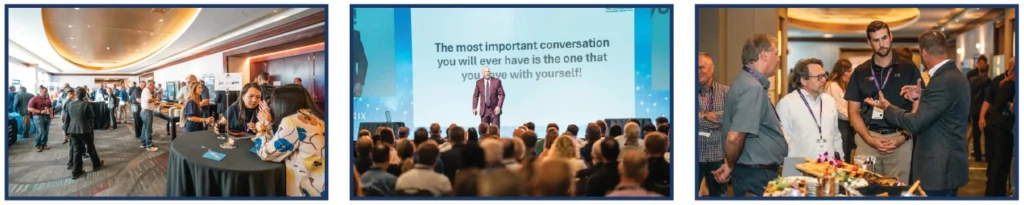
The Manufacturers Association for Plastics Processors (MAPP) created an environment for industry leaders, innovators and experts nationwide to explore the forefront of manufacturing technology and its impact on plastics manufacturing businesses. Those who truly invested themselves in the three-day conference embraced the meaning of “authentic influence,” building trust, loyalty and long-term connections. It’s as simple as people follow not because they have to, but because they want to – nourishing true authenticity between leaders, colleagues and others.
For the third consecutive year, attendees had the unique opportunity to explore the latest innovations and cutting-edge technologies in the Automation Hall, guided by 14 of MAPP’s leading automation experts. The conference featured live machinery demonstrations and interactive displays, providing participants with a real-time view of automation solutions.
“This isn’t just about sharing ideas – it’s about shaping what comes next,” said Conference Director Letha Keslar.
What Would a Brave Person Do?
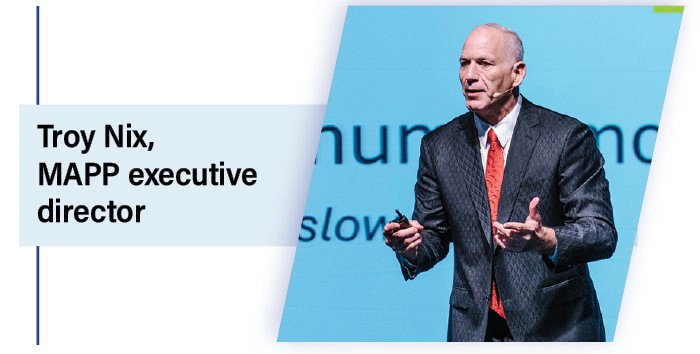
The master of ceremonies for several years now, Troy Nix, always wears his heart on his sleeve. Known for his spirit and enthusiasm for manufacturing, Nix delivered a keynote on lessons in leadership and how to cultivate a deeper connection with one’s inner self – tapping internally to inspire, motivate and create authentic influence. A pen could be heard if it dropped when Nix asked the audience, “What would a brave person do?”
In taking conference attendees back in time, Nix shared that he had set a goal for himself two years prior to stepping out of his comfort zone and joining a jiu-jitsu gym. This is where he began his journey of getting uncomfortable, but with that came small but mighty voices in his head that challenged him daily. With the initial goal he had set, Nix also added a second goal: joining a foreign jiu-jitsu gym that would push him beyond his mental and physical limits. As his story unfolded, Nix said, “I told my wife that I was going to the bank, but my telling her that scenario was more about avoidance of where I actually intended to go. As I was sitting in the drive-through line of the bank, I asked myself, ‘What would a brave person do?’” In his time of needing to battle the internal voices and external reality, Nix created “Troy’s Warrior’s Channel,” an instagram account filled with posts on mindset, attitude and self-improvement.
By taking action within himself, Nix went to the new, foreign gym and found… a community of people just like him:
- People learning.
- People practicing.
- People building camaraderie.
Nix went on to share, “When faced with the unknown, our minds write stories – usually turning the ‘unknown’ into fear.” His message was clear: What would a brave leader do? It is in the conversations one has with himself/herself that the most important conversations are had. Nix said, “Your life is a series of decisions. It begins with self-talk, because words matter. Sitting in the drive-through line of the bank, I was afraid – until those six or seven words fell out of the sky and my brain said ‘Go!’”
Encouraging the audience, Nix said, “Reframe your mind and ask yourself, ‘What would a brave person do?’”
Empower to Excel
At just 27 years old, at the peak of his life, Hymas’s world changed forever when a bale of hay fell onto him where he was seated on a tractor and shattered his neck, leaving him a quadriplegic. Speaking from his wheelchair on the stage, Hymas said, “Fear of failure – it’s not those that fail to get ahead, it’s those that fail faster. It’s the people who refuse to change what they’ve done in the past and their mindset. We rob ourselves…”
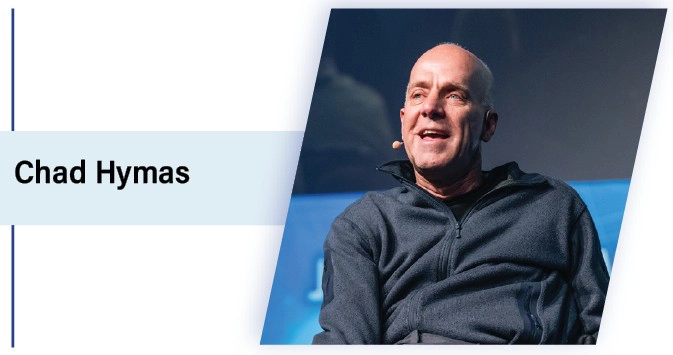
To expand his point, Hymas showed a video of himself in hunting gear, seated in his wheelchair behind a brush. The point? “It’s easy to stay stuck,” he said. During that time, he had no clear purpose or passion. But thanks to his dad, brothers, wife and sons who took him out to “God’s country,” he was pushed past a negative mindset and given a fresh perspective of adventure, bravery, courage and strength. “This message,” Hymas said, “is exactly the same as this conference – don’t cut yourself short. Get awkward quickly. Do not rob yourself of the opportunity that is in front of you.”
As Hymas reflected on the experiences that shaped who he is today, he returned to the day that changed his life – delivering a powerful message of purpose, passion and perspective. Sharing re-created clips of his accident, he spoke with conviction about every decision made that day – his own and those of the men who saved him.
He recounted how six cowboys arrived at the scene and, driven by pure adrenaline, lifted the massive bale of hay off his body, ultimately saving his life. Expanding beyond his personal story, Hymas drew a compelling analogy: Imagine someone bursting into the room, shouting that a school bus had crashed outside and children needed help. “How would you decide which child to save first?” he asked. The answer: The first child you see.
Just as those cowboys acted without hesitation and let the adrenaline carry them, Hymas urged the audience not to wait for the bus to tip over before stepping up to serve.
More information: www.chadhymas.com
Play to Win or Get Played: Inside the Mind of an Advantage Player®
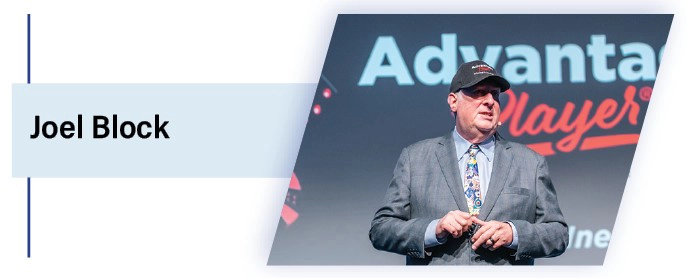
An “advantage player” is a term originating from the casino world – referring to someone who plays with an advantage. Block is a former professional blackjack player turned hedge fund manager who equips companies with strategies, insights and perspective to stay on offense, dominate their markets and control the game. From his experience, Block shared two key lessons:
- Professional card players have a good sense of what’s coming next.
- In life, a person either plays with an advantage or a disadvantage – and that person gets to choose.
He opened his keynote by asking, “What do advantage players have that makes them winners?” He followed it with: They play to win – not to lose. Block introduced a philosophy called TSA, which defines how advantage players operate:
T = Think in ways other people don’t.
S = See what other people don’t.
A = Act in ways other people won’t.
He emphasized with the audience that advantage players always find a way to win – just like business leaders. Block shared insights from his “Advantage Play System,” cross-referencing business strategy to blackjack. He said that the cards a person is dealt matter less than how they are played. The count determines the bet. The advantage comes from knowing what’s happening – at the casino table and in the business. With that, it’s in understanding the business’s market, prospects, workforce and more.
In closing, Block shared Five Killer Strategies for Advantage Play:
- Think Differently – Plant your flag and make it happen.
- See and Notice What Others Don’t – Interrogate, prepare and exploit weaknesses.
- Act Fast – Winners don’t wait for all the information; they act.
- Stimulate the Top – Solve workforce issues by investing in your winners.
- Even Winners Miss a Great Hand – Advantage players don’t always get it right. “But you’ve got to keep looking forward because that’s where victory lives,” Block said.
More information: www.theadvantageplayer.com
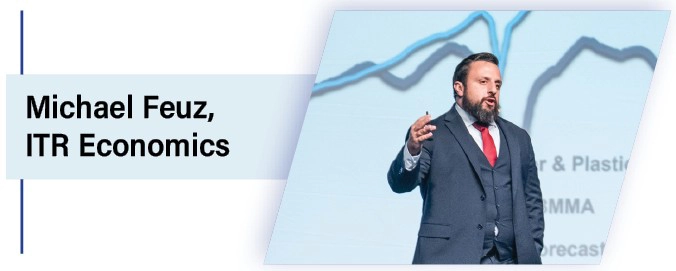
Manufacturing in the Era of Artificial Intelligence
As a key member of ITR Economics’ team of expert economists and consultants, Michael Feuz plays a vital role in producing client reports, conducting forecast reviews and delivering economic insights. At the conference, Feuz provided a look at key industries and the trends shaping their direction for 2025-2026. He examined market dynamics, the impact of events on domestic manufacturing and delivered actionable strategies. He told companies to capitalize on current conditions, anticipating potential inflation pressures in 2026. Additionally, Feuz pointed out the need for manufacturers to improve operational efficiency, address constraints and reduce dependence on labor growth over the next decade. His insights gave attendees actionable strategies and practical next steps to position their businesses for growth and resilience through 2026 and beyond.
More information: www.itreconomics.com
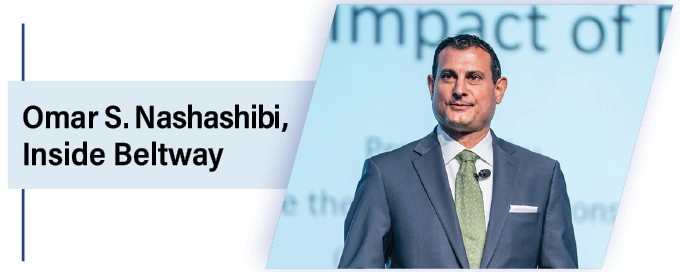
From Capitol to Factory Floor: Decoding the Impact of D.C. on Manufacturing
Omar Nashashibi is the founder of Inside Beltway, a nonpartisan lobbying and strategic consulting firm in Washington, D.C. As the manufacturing landscape evolves, Nashashibi shared with attendees that continuous advocacy efforts and trade negotiations have led to favorable conditions, also while addressing challenges such as rising material costs, tax and regulatory burdens and the need for a skilled workforce. He recommended that manufacturers continue to connect and build strategic relationships with advocacy groups and policymakers to ensure their concerns are heard and addressed, while staying informed about changing regulations and engaging available government resources.
More information: www.insidebeltway.com
Beyond the Buzz: How AI is Reshaping Manufacturing from Strategy to Shop Floor
This panel of speakers spoke about AI as a strategic necessity in manufacturing, not just a trend. The discussion was progressive as Moeller, who moderated the hour-long session, led this panel of leading manufacturers through various questions about how the plastics industry is leveraging AI to turn massive amounts of operational data into actionable decisions.
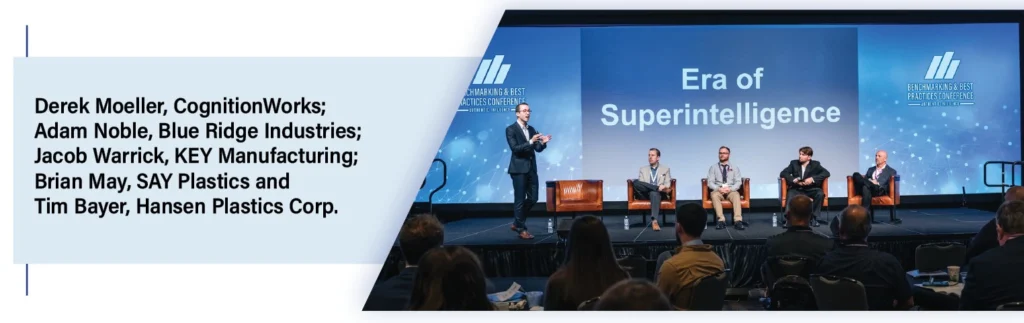
Panel Takeaways:
- AI is essential in manufacturing.
- AI delivers smarter, faster decision-making.
- AI improves and strengthens operations.
- For AI implementation to be successful, there must be strong leadership and effective training.
- People matter, so AI and technology alone are not enough.
Beyond AI’s role in advancing operations within companies, external factors (i.e., customer data) are equally important. A key point discussed by Moeller and Noble was the importance of using AI tools responsibly, particularly in protecting customer IP data. Through both internal and external AI adoption, the panelists offered recommendations for manufacturers to incorporate as they integrate artificial intelligence into their operational strategies, including aligning the company, engaging the workforce and starting with proven evidence-based applications. Moeller wrote on LinkedIn, “Want a successful AI deployment? Look for a system that has teachable memory (so they know your company better over time), that integrates into your existing data systems, and that adapts to your workflows – a chatbot is not the right workflow for every problem. (These are guiding principles for us in developing SprocketAI.)”
More information: www.cognitionworks.ai, www.blueridgeind.com, www.manarinc.com, www.sayplastics.com and www.hansenplastics.com