
By Patricia Ewald, product manager, PCS Company
Whether an injection molder requiring traceability, a die caster demanding batch control or a rubber molder relying on weekly and yearly tracking, date stamps offer a practical, inexpensive solution. They are a small tool with a big role in production success.
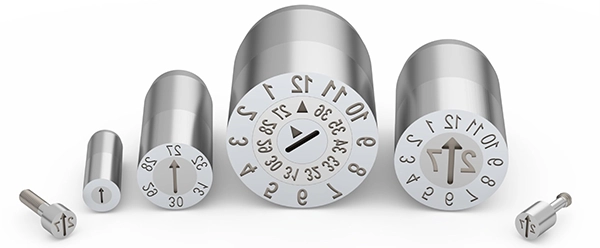
Why Date Stamps Matter
Date stamps are essential for providing permanent, molded-in traceability. The most common use of date stamps is to identify production dates, such as day, week, month and year, as well as shift or batch records.
They enable root-cause analysis for failures, support warranty claims and quality audits, and reduce the risk of full-batch recalls. Date stamps also contribute to quality assurance by ensuring every part is identifiable, preventing the mixing of old and new production, and, with the right configuration, isolating cavity-specific defects.
Operational efficiency is another key benefit, as date stamps support faster troubleshooting, quicker containment of quality issues, and reduced scrap and rework. Without date stamps, manufacturers risk rejected shipments, OEM chargebacks and unnecessary downtime.
Date stamps also support brand protection and anti-counterfeiting by creating a permanent molded-in identifier that can be matched to approved production records, batch history, shift data or cavity information. Missing, incorrect, inconsistent or unverified markings can indicate parts have been made without proper authorization or invalidate warranty claims.
The Right Stamp, the Right Result
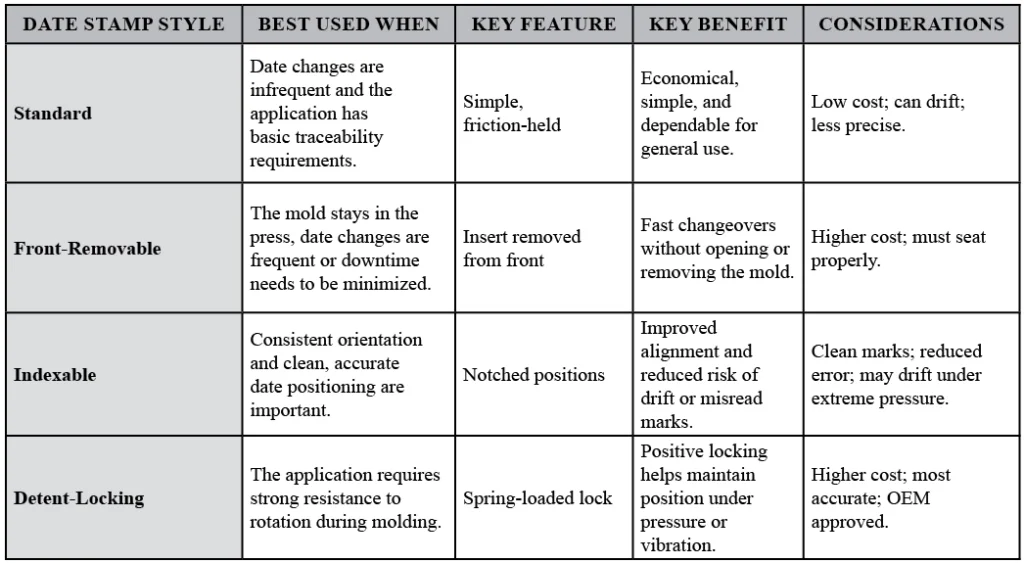
Choosing the right date stamp starts with understanding the application. Mold design, change frequency, alignment requirements and production environment all play a role in selecting the best style. Molders commonly rely on four options:
- Standard
- Front-Removable
- Indexable
- Detent-Locking Date Stamps
Each style offers distinctive benefits.
Standard Stamps
Standard date stamps are the most common and lowest-cost option. Their basic two-piece design, consisting of an outer ring and rotating insert, allows date changes when the mold is open. They provide basic traceability for month, year, day or batch identification and are adjusted with a hex key or screwdriver. Because they are friction-based with no positive lock, they are best suited for general molding applications with infrequent changes, standard pressure, clean molding environments and easy parting-line access. They are simple and economical but may drift under high pressure, and alignment depends on operator skill.
Front-Removable Date Stamps
Front-removable date stamp assemblies use a multi-piece design that includes an outer body, removable center insert, retaining feature, screwdriver slot and seating surface. This construction allows the center insert to be removed and changed from the parting line without opening or disassembling the mold. They are ideal for daily or weekly changes, hard-to-reach locations, deep cavities, cleanroom changeovers and high-volume production. Although they cost more and require proper seating to avoid misalignment, the time savings and reduced downtime often justify the added cost.
Indexable Date Stamps
Indexable date stamps are constructed with a fixed outer body and a rotating center insert that includes machined index positions, such as notches or grooves. These defined stops help the insert settle into precise, repeatable locations, improving alignment and reducing operator error. Indexable styles are a desirable choice for cosmetic parts, visible surfaces, standard-pressure molding, long production runs and industries such as automotive and aerospace where consistent date positioning is important. They may cost more than standard date stamps and may still drift under extreme pressure, but they provide cleaner, more
reliable marks.
Detent-Locking Date Stamps
Detent-locking date stamps use a fixed outer body and a rotating center insert held in position by a spring-loaded ball, pin or plunger that engages with machined pockets or notches. This positive locking design helps prevent unwanted rotation during molding, making detent-locking date stamps well-suited for high-pressure applications, high clamp tonnage, long cycles, cosmetic parts, strict OEM traceability, engineering resins, glass-filled materials, PVC, flame-retardant resins and die-cast applications. This style typically more expensive and may require more maintenance, but it provides the strongest positioning security and the most reliable traceability.
The Care Behind the Mark
Proper selection is only part of the equation. Date stamps perform best when they are treated like precision mold components and cared for consistently throughout production. Routine care, cleaning, installation and removal help prevent seized inserts, unreadable date marks, premature wear and misalignment.
The most important step in maintaining date stamps is routine cleaning. This may include wiping the stamp with a lint-free cloth and removing resin dust, gas residue or flash after each production run. Cleaning with a mild solvent or mold cleaner and using a soft brush on engraved numbers can help prevent sticky rotation, poor date marks and premature wear. Compressed air can help clear debris from the pocket.
Premature wear can be minimized by applying light machine oil or a tiny amount of dry film lubricant to the rotating insert. Avoid heavy grease, which may collect debris and avoid silicone sprays, which may migrate into the cavity. Lubricants should not be applied to the engraved face because oils may burn and carbonize.
Routine maintenance should include checking rotation after every changeover. Before putting the mold back into production, rotate the insert through all positions. Make sure it clicks cleanly, does not bind and aligns properly with the cavity. If rotation is stiff, clean and inspect for burrs.
Inspection is important for minimizing wear and ensuring the date insert remains in good working condition. Inspect engraved numbers for rounding or polishing, as worn numbers can produce faint or unreadable marks. Galling or scoring on the outer ring may indicate contamination
or misalignment.
When using a detent-locking date stamp, routinely check the ball and spring to make sure they move freely. Look for broken springs or flat spots on the ball. For removable types, inspect retaining clips and screws and confirm they are properly seated and installed.
In addition to preventive maintenance, temperature should be considered. High-heat molding materials, such as nylon and PEEK, can burn off lubrication, cause thermal expansion that tightens the fit, and carbonize residue inside the pocket. Temperature awareness, more frequent cleaning, and the use of a high-temperature dry film lubricant can be beneficial in high-heat environments.
During normal production, hex keys and Allen wrenches can be used to adjust the date and rotate the inner insert on date stamps. Small flat-blade screwdrivers may be used on date stamps with a slotted insert. Plastic or brass-tipped picks can help rotate stubborn inserts without scratching the steel.
During mold assembly, preventative maintenance (PM) or repair, installation and removal of a date stamp may require simple tools to get the job done. Retaining ring pliers are used for front-removable types with snap rings. Small brass punches can be used to gently tap out seized inserts without damaging the pocket. Soft-face hammers help seat the stamp body without damaging the mold, precision tweezers make it easier to manage small inserts, and a small torque wrench helps prevent overtightening of stamps with retaining screws.
Proper storage and organization help keep spare inserts clean, protected, and easy to identify. As a best practice, spare inserts should be lightly coated with rust preventative, stored in labeled containers, kept in a dry cabinet and never mixed with inserts from other molds.
A simple preventive maintenance schedule can help keep these practices consistent. Recommended checkpoints include,
- wiping and cleaning the date stamp after every run;
- applying light lubrication at each changeover;
- performing a full inspection during every PM cycle;
- checking the detent mechanism monthly or every 250,000 cycles; and
- replacing worn inserts as needed.
To prevent damage, never pry the insert with a screwdriver, as this can cause burrs, misalignment or damage to the cavity face.
Small Stamp, Big Return
When the right date stamp is selected, installed and properly maintained – the value shows up in measurable ways. Improved uptime, scrap reduction, OEM compliance, reduced labor and longer tool life all contribute to return on investment.
From traceability and compliance to uptime, scrap reduction, labor savings and tool life, the right date stamp helps molders protect quality and improve production performance. When carefully selected, installed and maintained, a date stamp is more than a molded-in mark; it is a simple tool that helps keep production stamped for success.
Patricia Ewald is a PCS Company product manager who is passionate about helping her clients solve challenges through new and innovative products and services. She recently earned her Associate of Business Administration degree with a concentration in marketing from Macomb Community College in Michigan. Ewald has worked for more than 25 years in the plastics industry, with positions in sales, purchasing and product management.
More information: www.pcs-company.com