
By David Hoffman, Jaemin Aoh and Nora Ganzil, AIM Institute
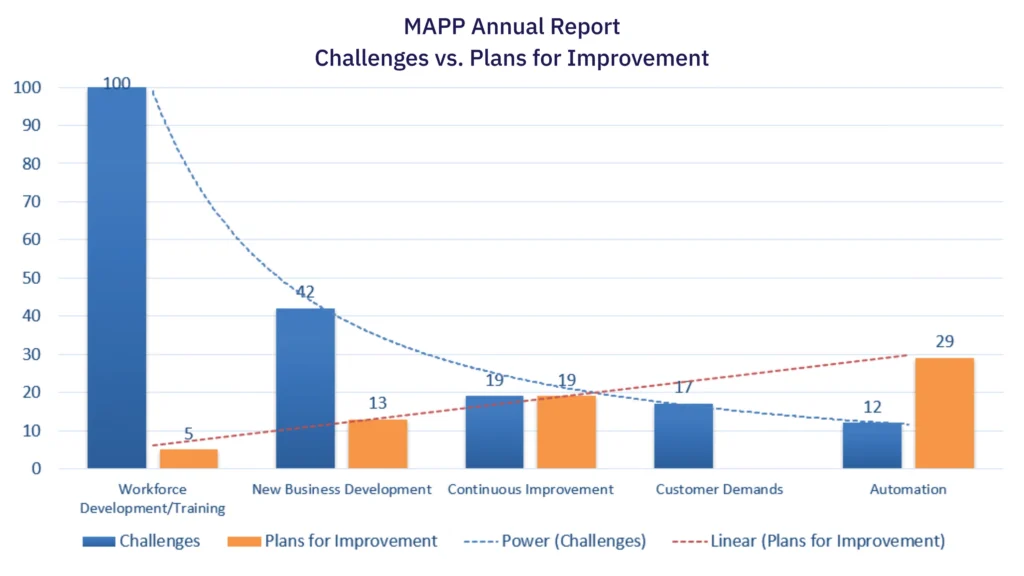
If a room of manufacturing leaders is asked to name their biggest business challenge, workforce development almost always tops the list. Yet, when looking at where those same companies actually allocate their annual spend,
a contradiction emerges.
Despite being the industry’s primary concern, workforce development and training fall to the very bottom of the spending list, while equipment and automation rise to the top (Figure 2). There is a clear disconnect between identifying the workforce challenge and resolving it.
Why the hesitation? Often, managers fear spending time and money on employees who might simply take their new skills to a competitor for higher pay. But research points the other way. According to LinkedIn’s Workplace Learning Report, 94% of employees say they would remain longer at a company that invests in their development.
David Hoffman, director of the AIM Institute, has spent a decade addressing this contradiction. “The data reveals companies typically direct their spending toward equipment and automation, and focus less on their key differentiator: their people. The challenge is not just a skills gap; it’s a knowledge gap,” Hoffman said. “We see a variety of folks who are doing the job they are asked to do, but they often don’t understand why they are doing what they do. They don’t see how plastic materials, mold design, injection molding and part design all play together in their specific role within the company.”
Bridging that gap empowers employees to innovate, solve problems and find better, more efficient ways to work. That deep knowledge is exactly what separates education from training.
Education vs. Training on the Shop Floor
Understanding the difference between skill and knowledge is critical for an operation. AIM speaks of education and training as a pair, not as substitutes for one another. The industry needs both, and the difference is easiest to spot on the shop floor:
- Training (Skill): Teaching someone what to do. For example, training teaches a process technician that when a part warps, changing the pack pressure can fix the issue. A skill is a task performed without necessarily understanding the why behind it.
- Education (Knowledge): Teaching someone why it happens. Education provides a thorough understanding of the various root causes of warp so the appropriate corrective action can be applied – which might be completely unrelated to pack pressure.
AIM’s approach to troubleshooting is embedded in teaching students about all aspects of injection molding, minimizing the time needed for root-cause analysis. Getting to that level requires a holistic view.
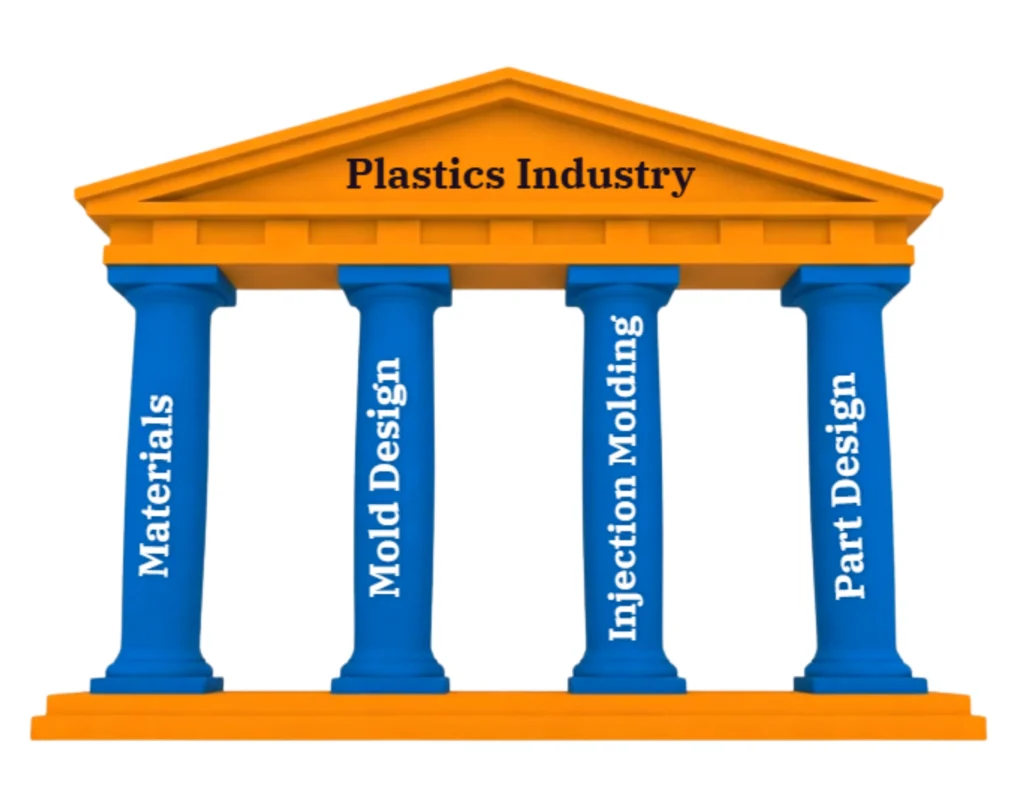
Regardless of a person’s specific job function, AIM believes that individual should be familiar with the four pillars of the injection molding industry: Plastic Materials, Mold Design and Engineering, Injection Molding Processing and Part Design (Figure 1).
A Decade of Evolution
None of this was drawn up with blinders on. AIM’s curriculum was developed one request at a time as companies came to Beaumont for help with specific problems: A quality department needed its people to understand molding; a process group needed to understand mold design; a production team needed to understand the meaning behind machine settings.
Over time, these targeted courses morphed into two primary pathways: the hands-on Molders’ Series and the comprehensive Plastics Technology and Engineering (PT&E) Program. Today, AIM offers pathways ranging from four-hour onboarding courses up to a two-year Associate of Applied Science (AAS-AT) degree in partnership with PennWest University.
The Institute also is an authorized Autodesk Moldflow training provider and recently opened its Mold Maintenance Center of Excellence, a hands-on facility dedicated to predictive mold maintenance and repair.
Any provider can call its programs “rigorous,” but few can stand behind the claim. AIM did. The Institute voluntarily put its programs before the ANSI National Accreditation Board. AIM offers the only accredited courses and programs in the plastics injection molding industry outside of a university (accredited to the ANSI/ASTM E2659 standard).
This accreditation relies on an industrial advisory board featuring leaders from SABIC, GM, Autodesk, W.L. Gore and Associates, Ping Golf and more. This board reviews every lesson, learning objective and exam question, driving a continuous cycle of revision and improvement based on day-to-day operations and industry demands.
How Workforce Evaluations Empower Employers
Accreditation tells an employer that an education program is sound, but it doesn’t tell them where their own teams stand or what gaps need to be closed. Those are the questions AIM’s Workforce Evaluations were built to answer with data. These evaluations benchmark a company’s team – and each individual – against established industry averages across a variety of topics. AIM then meets personally with the management team to review the results, acting as guidance counselors to prescribe individualized learning pathways (Figure 3).
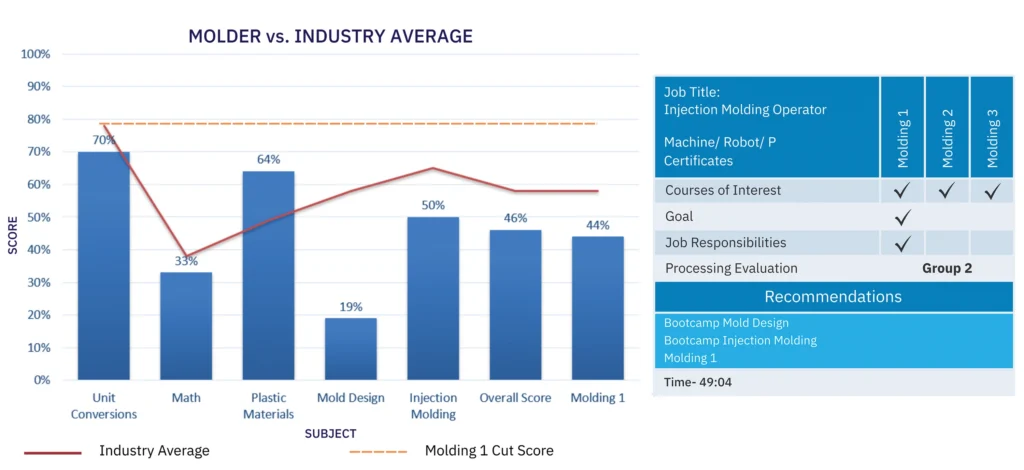
Sometimes, this means advising against a specific course. A molder with over 10 years of experience might assume they belong in the Molding 2 course. However, if that individual is not currently performing the specific job functions taught in that course, AIM will recommend the Molding 1
course instead.
As Jason Travitz, AIM’s senior injection molding instructor, said: “We want a person’s feet to be where their head is.”
Once a pathway is prescribed, AIM tracks student performance using pre- and post-testing for both knowledge and machine skills. Ultimately, the goal is to have students leave the AIM Institute knowing more than they did and being able to do more than they could.
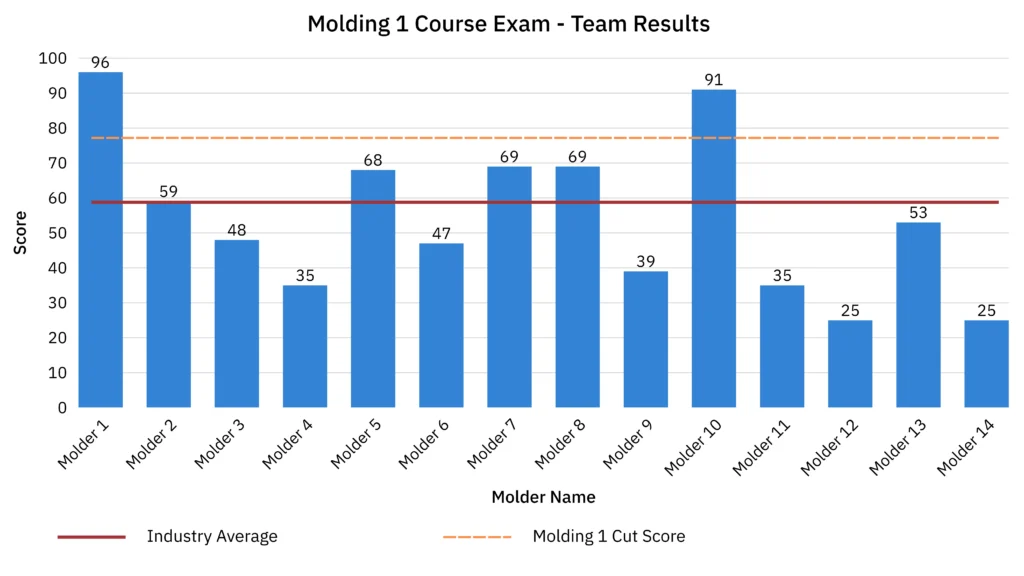
Looking at group data provides management with a clear assessment and invaluable roadmap. For example, Figure 4 illustrates that only two of 14 employees surpassed the cutoff score for the Molding 1 course, while the majority sat below the industry average. While this data clearly highlights which team members have the potential to become future leaders, it also prompts leaders to ask a critical question: “What if our top performers walk out the door?”
By directing attention to the learners scoring just below the top tier, AIM helps companies build their next “A-tier” class of employees. As overall average scores improve, operations become steadier, more secure and less reliant on a single individual, effectively mitigating business risk.
Proof on the Shop Floor
A workforce grounded in real education can shoulder the work a checklist cannot cover. One company that prepared its education and training plans with AIM instructors serves as an example:
Schweitzer Engineering Laboratories (SEL): Mechanical Engineer Matt Funke ran a five-person toolroom capable of building 13 molds a year. Unable to keep up with additional work, the obvious solutions were expensive: hire more people, buy more machines or outsource. Funke chose a different route and enrolled in the PT&E Program. By applying a new approach to designing and building molds, output rose from 13 to 50 molds within a single year (a 285% increase) with the exact same headcount. By designing tools to run the first time correctly, reducing cycle times and minimizing scrap, SEL saved $2.4 million by avoiding outsourcing.
The Approaching Demographic Cliff
The urgency for structured education is accelerating. A 2021 report by Deloitte and The Manufacturing Institute estimates that 2.1 million manufacturing jobs could go unfilled by 2030, costing the economy up to $1 trillion if the current skills gap trajectory holds.
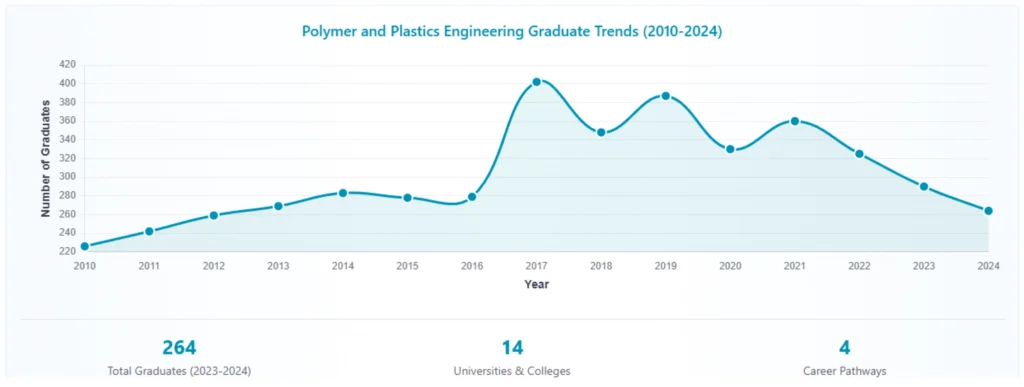
Simultaneously, the pipeline for specialized plastics engineers is shrinking. According to a 2026 whitepaper on thermoplastic educational needs by AIM Senior Instructor D. M. Rose, graduates from Polymer and Plastics Engineering programs have been declining. In 2023, there were only 290 graduates across all degree levels (a 10.8% decrease from the previous year). With roughly 10,000 plastics and resin manufacturing facilities in the US, that leaves one plastics engineering graduate for every 59 companies (Figure 5).
Adding bodies does not automatically transfer knowledge from retiring baby boomers to the next generation; a designed education and training program does. AIM built the PT&E Program as a workforce strategy on exactly that premise.
The workforce evaluations all point the same way: data displaces bias. A company gains a clear view of where its people stand and where they can go. Many employers are ready to hire and pay for education; the harder part is knowing in which direction each person should be aimed.
After more than 10 years in the industry, that is the challenge AIM has taken lead. Not the hero of any company’s story, but the guide, helping leaders see the whole picture and invest in the one thing that truly sets them apart: their people.
David Hoffman is the director of the American Injection Molding (AIM) Institute, a Beaumont organization, where he developed the core curriculum for its accredited courses and programs. A plastics engineer and co-inventor of Beaumont’s MeltFlipper MAX technology, Hoffman also is a published author. Throughout his career, he has been dedicated to translating the complex science of injection molding into accessible, high-quality education and training.
Jaemi Aoh is a creative director at Beaumont and the AIM Institute, with a career built on design leadership across product teams – both domestic and international – at Fortune 500 companies. Earlier roles include senior lead experience researcher at IBM/Kyndryl and nearly a decade shaping user experience at Erie Insurance Group, where Aoh built the company’s internal design pattern library and led a rebrand of its corporate identity. Aoh has a Bachelor of Fine Arts in Graphic Design from James Madison University.
Nora Ganzil is a content marketing specialist at Beaumont and the AIM Institute. She manages the institute’s social media, press and customer storytelling. Ganzil holds a master’s degree in strategic communication from Gannon University.
More information: www.aim.institute and www.beaumontinc.com
E BG1`