
By Liz Stevens, writer, Plastics Business
Artificial intelligence (AI) rapidly is reshaping business operations across industries, and plastics processing is no exception. Companies increasingly are exploring AI tools to improve efficiency, streamline workflows and support decision-making throughout their organizations.
ADMO, Inc., Elgin, Illinois, provides tooling and design, injection molding, finishing and assembly services. Facing a manpower crunch and the need to streamline project management, the company turned to artificial intelligence tools, becoming an early adopter of AI. The company contributed to MAPP’s 2025 Best Practices Book with examples of its AI implementation, including use in administration, human resources support, industry intelligence, project management, risk analysis, business information queries and technical guidance. ADMO found that structured use of AI in conjunction with Microsoft Teams accounts and Microsoft SharePoint can raise efficiency across multiple business functions. With its use of OpenAI’s ChatGPT and Microsoft 365 Copilot Chat, alone and in concert with other technology tools, the company is setting examples for successful implementation of AI.
According to Andrew Carlsgaard’s Plastics Business Benchmarking article, “AI a Growing but Underutilized Technology in the Plastics Processing Industry: 2025 AI Adoption Survey,” 1 plastics processors report that key motivations for AI investments include improving production output, employee productivity and operational agility. Administrative, finance, IT and production functions are among the most active areas for AI adoption.
Choosing the Right AI Platform
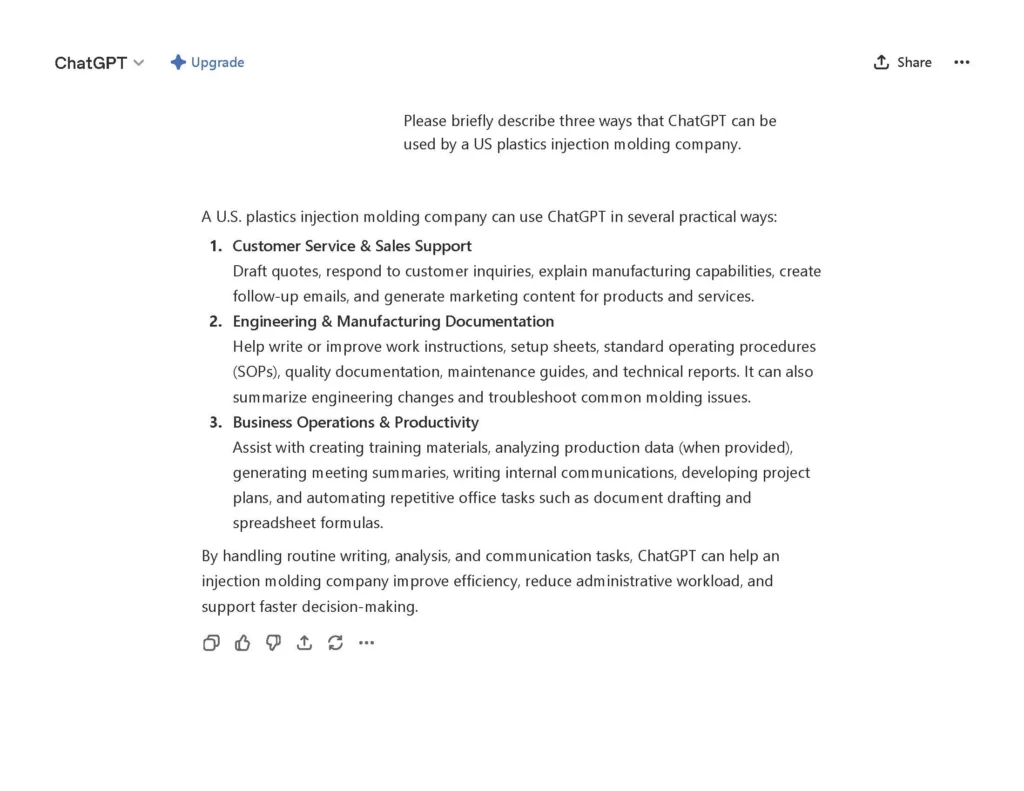
Exploring AI requires two major decisions: whether or not to try it at all, and which of the many AI tools to use. ADMO’s Christy Giardino, director of administration and information systems, described her AI decision-making process. “I was not an early adopter of AI,” Giardino said. “I had concerns about how models are trained and about potential intellectual property violations.” For a personal issue, Giardino decided to try ChatGPT. “I described the challenge and gave the bot guidelines for what I wanted in a response,” she said. “The response was spot on and truly helpful. This led me to wonder if I could use AI for challenges at work. I began exploring by developing a personal assistant with ChatGPT.”
The help that Giardino needed at work revolved around repetitive tasks, reminders and research. “We were facing a turbulent time in the economy and in the geopolitical sphere,” she said, “and it was increasingly difficult to keep up with developments and risk assessment.” Considering this, Giardino wanted to develop ChatGPT prompts to help her track important data and news that was available on
the internet.
After watching a few videos showing the use of AI for this type of task, Giardino began “talking” to ChatGPT. “This was difficult for me because I did not grow up ‘talking’ to technology,” she said. “It seemed silly at first, but I have come to appreciate this easy way to request help.” Giardino worked with the AI bot to create a plan for communicating using a private Microsoft Teams channel. This allowed her to quickly access the prompts she regularly used. With ChatGPT’s help, she also developed a Microsoft SharePoint page to manage weekly dashboard items.
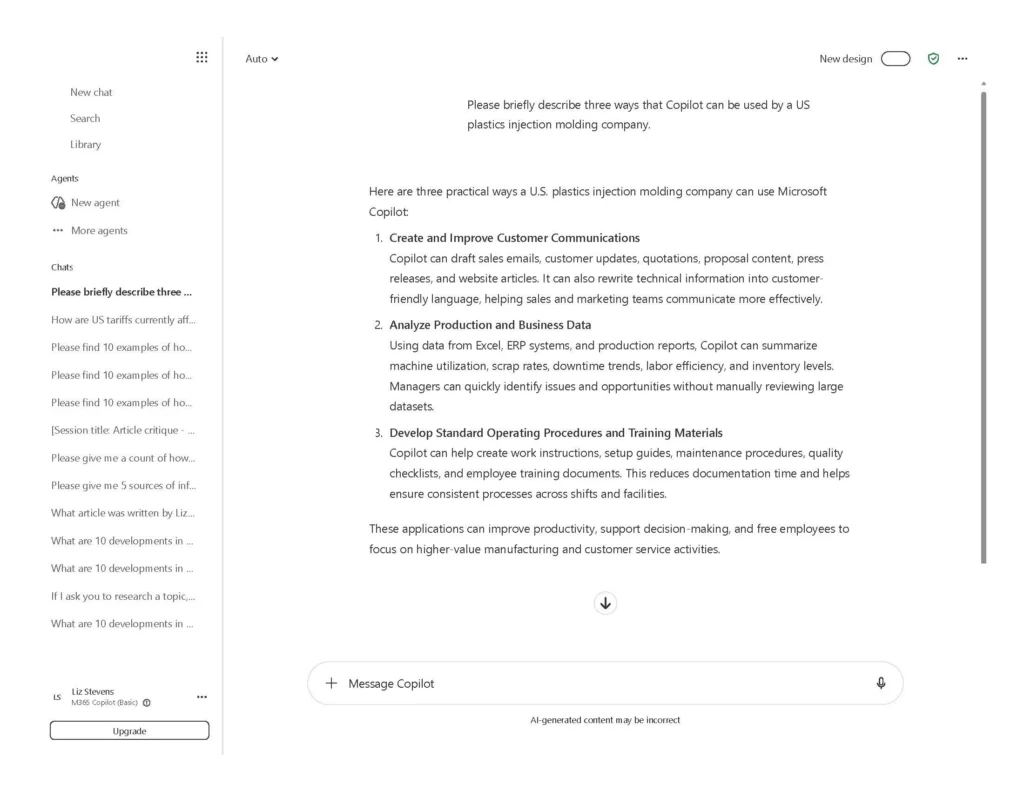
At the start, Giardino also considered using Microsoft 365 Copilot Chat since ADMO uses many Microsoft products extensively. “At that time, I wasn’t having much success using Copilot, and so I chose to use ChatGPT,” Giardino said. “We have, however, changed course on that since Copilot has significantly improved. It offers better access to ADMO’s internal documents, which was something that ChatGPT could not reliably handle.” Giardino now uses Copilot to develop “agents” – AI systems that help manage tasks – and she continues to use ChatGPT for projects where its performance is superior to Copilot.
One of the advantages of using Microsoft’s AI is that, as a longstanding software provider, Microsoft has suites of products and applications with which its AI tool can interact. Microsoft 365 Copilot Chat, however, is not solely a Microsoft product; it uses GPT-5 as its core intelligence engine while integrating with Microsoft’s suite of apps.
Implementation Examples
ADMO has implemented AI as a digital assistant across its administrative, human resources and information systems departments. For project management and reporting, ADMO created SharePoint dashboards to track projects, tasks and progress. “Our weekly status updates are drafted and summarized with Copilot, providing executive-ready highlights and team member accomplishment recognition,” Giardino said. The dashboards include summary and detailed views that present to-do lists, accomplishment recaps, ongoing projects and other time-sensitive information. Giardino maintains a list of the prompts for updating these reports and has used ChatGPT as an assistant to write Python code for some tasks. “Having an AI tool that can help with Python programming has been immensely helpful,” she said.
Gathering and presenting risk analyses and geopolitical briefings are another area where ADMO has used ChatGPT and Copilot. A news update dashboard, for example, captures timely information on ADMO’s customers and its competitors, too. A risk-and-opportunity dashboard tracks developments, such as tariff volatility, regulatory changes and competitor activity. AI can compile and summarize this information in minutes, substantially reducing the time required for manual research.
ADMO uses AI to get the most out of the data in the company’s DELMIAWorks ERP system. “ChatGPT doesn’t have direct access to our system,” Giardino explained. “But by using reports exported from the ERP system, we can use AI to quickly engage with that system data.” For dashboards and Structured Query Language (SQL) queries, she turns to ChatGPT for assistance. “Using AI in this way delivered the most immediate benefit,” she said. “I had struggled for two years to get the dashboards to work correctly. With ChatGPT’s help to refine the queries and the structure, I was able to produce more than 30 dashboard charts in a day or two.”
Artificial intelligence has been valuable to ADMO in its human resources department, although it is not integrated into the company’s HR system. “We are using ChatGPT and Copilot as coaching tools within our HR department,” Giardino said. “They help us think through situations, gather information and improve communication.”
Giardino has used AI to research the impacts of certain HR-related laws, to analyze contracts and clarify dense legalese, and to evaluate employee conflicts and offer suggestions for conflict resolution. “My team often will use it to check the tone and appropriateness of communication, especially in difficult situations,” Giardino said. A novel aspect of AI bots is that users can ask the bot to give responses in a tailored way. Presenting responses in a positive tone, for example, can be a standing order for all human resources feedback that an AI bot delivers. AI, however, can do more than regurgitate information in a specified manner. “It also is very helpful to ask an AI tool to challenge your thoughts or give you new ways to look at a situation,” Giardino said.
For leadership and personal development, ADMO uses AI to manage an online library of leadership-oriented books. The company also uses AI for team coaching, improving communications and maximizing collaboration among the ADMO associates. The AI bot can make suggestions for dealing with the workforce based on widely known employee personality types and characteristics.
ADMO used assistance from ChatGPT to create an internal health guide for employees. The guide covers diabetes, including information about the condition and links to valuable health resources. “After an employee expressed concern about a new diabetes diagnosis,” Giardino said, “we used ChatGPT to research the topic and create an empathetic, practical and accessible health guide. The guide was added to our SharePoint employee resources and translated into Spanish for greater reach.”
AI, Job Orders and Plant Floor Topics
ADMO uses ChatGPT as an aid in order entry validation. “Copilot reviews sales order confirmations against system entry reports to detect discrepancies,” Giardino said. “This reduces data-entry errors and provides faster issue resolution. We do this by exporting an order report from our ERP system; we upload that report plus the original order document from the customer. The AI bot checks this against a list of order items that need to be verified. This is helping to reduce the manual work involved in order processing.”
AI’s analytical and pattern recognition traits help ADMO understand molding defects and reject trends. “Our rejects are captured by the Quality team, which submits hold tickets via a Google form,” Giardino said. “I then submit Microsoft Excel sheets with aggregate defect/reject info to ChatGPT, requesting an analysis of common reported issues or repeated issues with specific parts or molds.” ChatGPT makes suggestions for corrective actions on issues like burn marks, flow lines and knit lines. “It might suggest that contamination is the source of the problem,” she said, “or it may suggest that the preventive maintenance schedule for a mold should be adjusted to prevent problems.”
ADMO has created a way for ChatGPT to provide technical plastics injection molding insight. “I create projects within ChatGPT, so I am able to concentrate specific knowledge in one place,” Giardino explained. “I have given ChatGPT internal documents related to processing and troubleshooting to train it, but we have turned off the training of the model for broader purposes to make sure that the internal information we feed it stays within our organization.” By tapping ChatGPT’s knowledge of molding principles, ADMO employees can resolve technical questions or access a qualified list of suggestions to submit to the company’s technical team to address problems.
Validating AI Performance, Safeguarding Proprietary Information
Verifying AI-generated information remains essential. These tools can make up answers (hallucinating) and present the phony answers with seemingly indisputable authority. “For testing ChatGPT’s performance,” Giardino said, “I check to see whether the information offered is in line with what I was expecting or matches my prompts. In some cases, I must try different prompts. I ask for links to the articles it references so I can verify the source material.”
Protecting proprietary information is another critical consideration when deploying AI tools. In this regard, Giardino makes a distinction between working with ChatGPT and working with Copilot. “For ChatGPT, we have it set up to not allow the model to be trained; this should keep our internal information safe,” she said. “However, on a broader scale within the company, we are using Copilot because it retains the same access rights
(and information security) that are assigned within our Microsoft suite of tools.”
Advice for AI Exploration and Implementation
Giardino shared advice for working with AI. “With this technology,” Giardino said, “caution is key. The more a person works with AI tools, the more the tools can feel like reliable coworkers or even friends. But we always need to keep the human in the loop to catch AI hallucinations or outdated material.”
Giardino urges users to directly ask an AI tool how it can be helpful. After first introducing one’s company with bullet points about the business, AI then can be asked to describe how it can be of service; the response can be surprisingly wide-ranging and detailed. When zooming in on particular areas for assistance, it is wise to provide enough detail to keep the AI tool focused. “In the beginning, I spent time thinking through the ADMO areas that could benefit from AI,” Giardino said, “and then I asked ChatGPT what it could do in those areas and how we could lay out the process for accomplishing the tasks.”
It is common to ask for revisions or to tweak a request, or even to tell the AI tool to be more succinct or, conversely, to respond in more depth. And an AI tool can be asked for guidance on how best to communicate with it, including how to present requests, how to structure input for detailed tasks or how to manage a large body of requests. Users must remember that AI is operating from the body of information it has been trained on. It is helpful to ask the bot how recently its training has been updated to understand whether its knowledge is up to date.
“I have found AI to be useful in many ways, and I know that I have just scratched the surface of its potential assistance,” Giardino said. “We will continue to grow in our use of AI in ways that make sense for our business and that streamline the workflow for our team.” Giardino’s final bit of advice for approaching AI: “Watch some videos of how people use a particular AI tool. Ask your friends questions. Then pick a task or a process and give it a try.”
Giardino’s experiences while exploring AI tools and implementing ChatGPT and Copilot at ADMO demonstrate that this technology can assist plastics processors in many areas of their businesses. ADMO has used it in administration, human resources, ERP data analysis, job order validation and tracking processing issues. The AI tools have helped the company accomplish more with greater efficiency, faster speed, fewer errors and broader insight into its own operations as well as the industry at large.
References
- “AI a Growing but Underutilized Technology in the Plastics Processing Industry: 2025 AI Adoption Survey,” Andrew Carlsgaard, Plastics Business, 2025, Issue 4. https://plasticsbusinessmag.com/articles/2025/ai-a-growing-but-underutilized-technology-in-the-plastics-processing-industry2025-ai-adoption-survey/
More information: Christy Giardino, cgiardino@admoinc.com and www.admoinc.com