
By Graeme Sands, general manager, Globeius
One of the pillars of efficient, productive injection molding operations is the orderly and safe storage of all those intricate and expensive molds.
Conscientious molders take inventory management seriously to protect their employees and supercharge their productivity. Traditionally disorderly – and potentially dangerous – mold storage is giving way to purpose-built rack-and-crane systems that streamline molding operations to an unprecedented level.
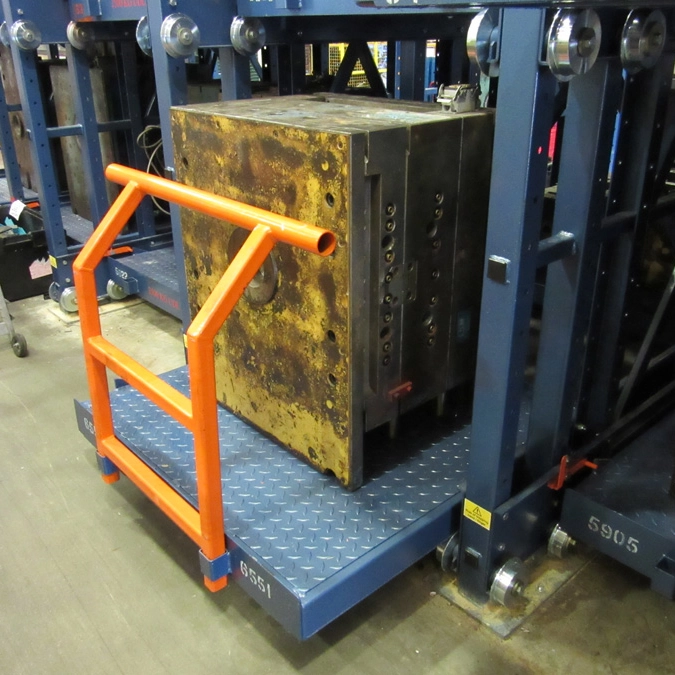
For years, and to this day, molders without contemporary storage solutions have had to “double pick” molds by selecting one off a rack, setting it on the floor, then picking the desired mold from the back of a shelf. Some molders with racks store their molds on palettes in those racks – wasting valuable space.
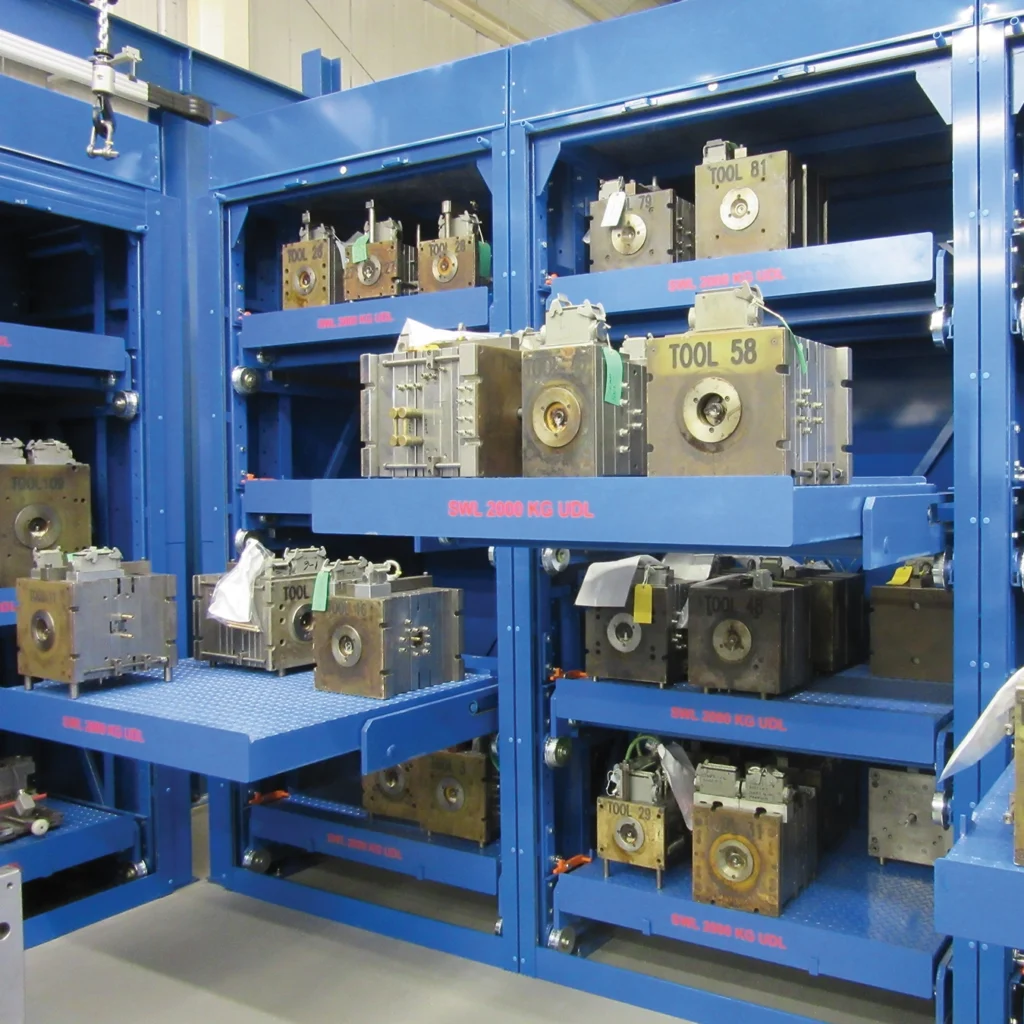
Modern mold storage racks give molders complete control over their mold inventory and their premium floor space. For instance, a 10 sq. ft. storage space can be turned into 40 sq. ft. of storage with a four-shelf system. Makeshift mold storage racks or those not built with mold storage in mind must be set apart with enough space to allow a forklift to turn through 90° between the bays. Twice as many specially engineered mold storage racks with sliding shelves can be housed in the same space.
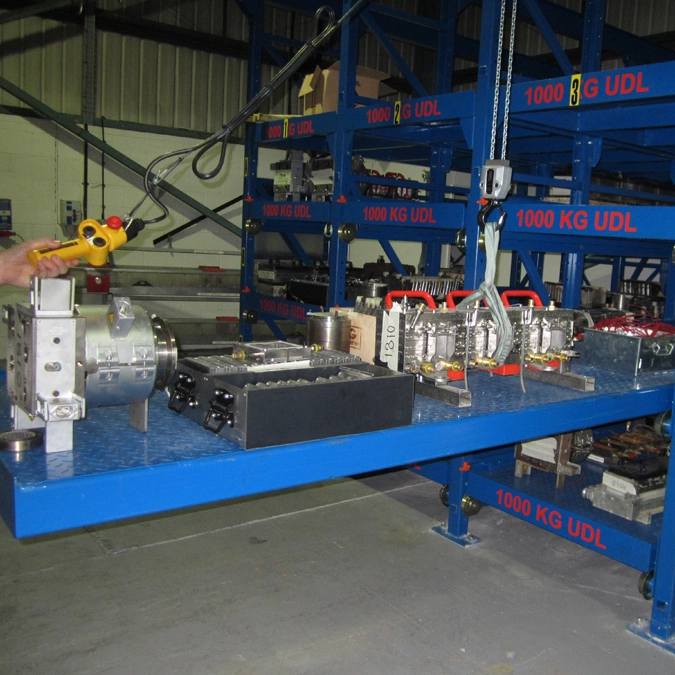
As for the shelves, properly leveled contemporary mold-storage racks let personnel pull out molds weighing up to 4,500 lbs by hand. Racks can be purchased with shelves that extend 100% or partially (63%). Within reason, molders can stack several molds on each drawer. Traditionally, molders could only put one mold in a given location because they couldn’t pick up one mold and lift it over another without running into the ceiling or knocking off the mold in front. Now the molders can pull the drawer all the way out and get to the mold in the back.
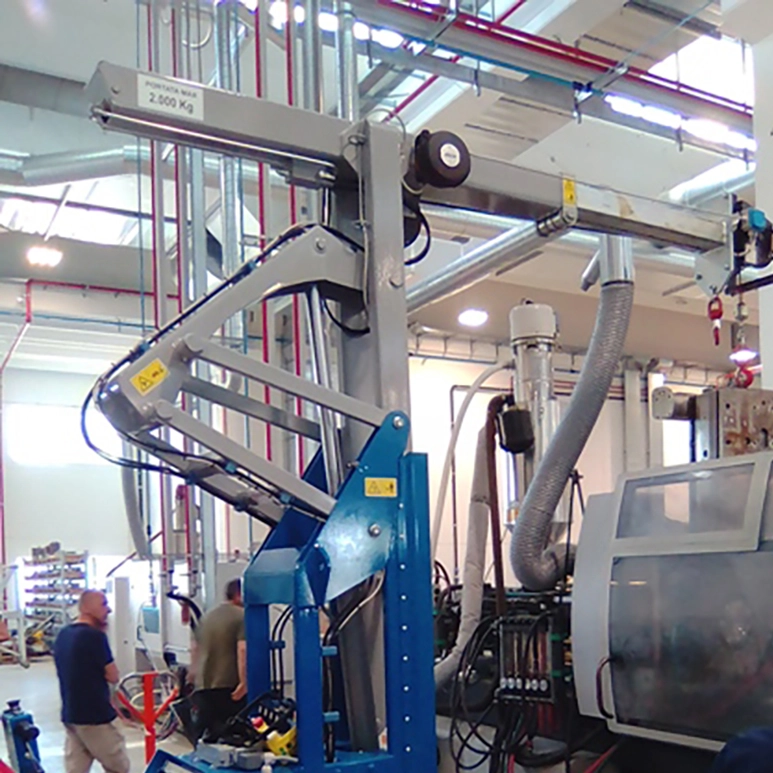
Meanwhile, cranes designed specifically to complement contemporary mold storage racks can not only move molds but also set them into molding machines from either the ends or sides. When personnel are lifting things that have a lot of mass to them, the last thing they want to do is second-guess whether what they’re using to carry these objects will be able to pick that up on a regular basis without it falling on someone or damaging the equipment. Today’s user-friendly mold-moving cranes use limit switches to ensure there is never an overload situation and an on-board display to show exactly how far the specific load on the hook can be extended. They also feature power steering and remote control operation – a step up from the traditional forklift.
Case 1: Medical Molder’s Space Crunch
Many injection molders operate in older facilities where space is tight. Moving expensive, heavy molds safely demands the right transport and storage equipment.
Then there is the matter of outgrowing mold storage as more tools are acquired and the business grows. Older storage solutions that worked for years can simply
become outdated.
That is the kind of space crunch many injection molding shops can face as growth happens. For instance, one medical molding shop in the Southern US found itself hampered by an aging storage system that had grown quite cumbersome. Production floor personnel built makeshift workarounds to store the 125 molds in inventory – most of them changed once a week. And, the facility cannot accommodate overhead cranes, so operators have been using mini cranes. That worked until the molder began purchasing heavier molds – the first weighing 6,500 lbs – that exceeded the carrying capacity of its mini cranes.
After researching options, the shop settled on a more modern solution engineered specifically for efficient mold storage. The benefits for that shop were immediate, as it was able to:
- Free up almost four of its original five racks and recover 75-80 ft. of floor space because the racks could be positioned closer to the wall.
- Move and set molds more safely with a crane that can carry molds up to 8,400 lbs.
- Plan to increase its inventory to 200 molds or more.
- Use personnel better – now, just one operator can set a mold instead of two or three.
- Train crane operators quickly thanks to easy-to-understand controls and power steering.
Case 2: Managing Many Changeovers
Roland Plastics in the U.K. has made several recent upgrades to modernize its facility – and robust mold storage racks were among its improvements. Molding parts for the automotive, medical, defense and consumer goods industries, Roland needs a well-organized production area for fast changeovers.
“We recently upgraded our warehouse with heavy-duty racking specifically designed to house our growing collection of mold tools,” Roland Plastics wrote in a LinkedIn post. “Safe, efficient and built to handle the weight of even our largest tools, this new setup helps us stay organized and production-ready at all times. A small but mighty improvement behind the scenes!”
The company listed all the benefits it realized from purchasing its special-purpose mold storage racks in an April 9, 2025, blog post:
- Safe, secure tool storage.
- Available warehouse space is maximized.
- Molds can be accessed faster, cutting downtime.
- Tools handled properly last longer.
“Each of our injection molding tools is a key asset, carefully designed and maintained to exacting standards,” Roland said. “This new system not only protects those investments but helps us stay production-ready at all times.The decision to invest in upgraded tool storage reflects our wider commitment to scaling sustainably. As we support more customers across the UK and beyond, our internal operations need to grow with us. Smarter storage is a key part of that.”
Case 3: Thousands of Molds
Another molder grapples with over 4,000 molds of many sizes. By acquiring contemporary mold-storage racks designed exclusively for that purpose, it has eliminated all forklifts from its shop floor. In one instance, over 30 molds can be stored in a 78″ space.
The company calculated thousands of dollars in cost savings annually by eliminating not only its forklifts (and maintenance costs) but also dramatically reducing the cost of production staff looking for tools or double-handling them to move them into the molding machines. Other savings include less insurance and fewer tool damages.
Another selling point for the company is the ability to show customers its streamlined storage setup – a level of attention to detail that affirms the molder’s commitment to efficient production.
An Investment That Lasts
With mold costs often running into the hundreds of thousands of dollars, protecting those assets is vital to a molder’s bottom line. Ensuring employee safety is another significant way molders ensure efficiency by avoiding costly accidents. Ultimately, the equipment molders use to store and retrieve their costly tools is as important an investment as the tools themselves.
Graeme Sands is general manager of Globeius. With a mechanical engineering degree from the University of Wales, he worked in the automotive industry in the UK before moving to Canada in 1993 to join the plastics industry, working for MoldMasters. A career focused on the hot runner and temperature control industry took him to American MSI, Yudo and back to MoldMasters as global director of product management. In 2018, Sands joined the Plastics Solutions and Globeius team and works out of his home in the Toronto area.
More information: www.globeius.com or graeme_sands@globeius.com