
By Liam Kelly, commercial solar account executive, Artisun Solar
“When’s the last time you changed something in your business before you had to change something in your business?” said MAPP Executive Director Troy Nix. He asked this question during the kickoff of the 2025 Annual MAPP Meeting last December. For an industry already navigating the constant fluctuations and pressures from costs, labor and supply chain disruptions, the question challenges the familiar pattern of reactive decision-making.
Between AI and automation, the focus of the meeting was to help members drive solutions that, as Nix said, “… beat everyone else to the punch.” However, AI and automation are just the tip of the iceberg to remain competitive in the plastics industry.
Energy is emerging as one of the next threats, forcing its way into the conversation. It’s the next line item that separates companies that proactively address it now from those who stay behind.
Energy Rate Shifting Higher
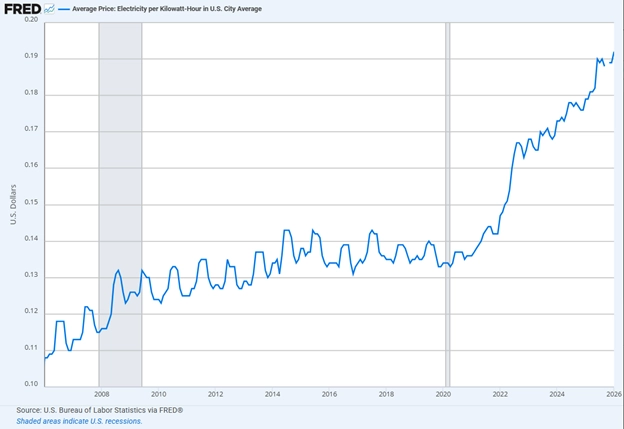
If energy costs feel like they’re higher than ever, that feeling is right. According to the US Bureau of Labor Statistics via FRED®, a look back at the average energy prices over the last 20 years shows a clear trendline. Starting in 2006, electricity costs climbed slowly but steadily over a 15-year span. This gradual pace gave manufacturers time to absorb incremental increases in energy.
As Figure 1 shows, the average cost per kilowatt-hour has skyrocketed, jumping 41% from January 1, 2021, to January 1, 2026. For perspective, prices increased faster over five years than they had in the previous 15 years.
For plastics manufacturers, that acceleration has a direct impact on the cost of every pound of plastics processed. While energy once was a relatively stable line item on the profit and loss statement (P&L), energy has become one of the most volatile variables in the production cost equation.
Drives Behind Energy Increases
One of the questions business leaders often ask in response to Figure 1: What is the driving force behind the increases, and how will these forces impact the future of energy costs?
The US Energy Information Administration reported that climbing fuel costs in 2021, especially natural gas, were a major factor in a rise in wholesale electricity prices in all regions. In 2022, a new threat emerged. With the launch of AI tools like OpenAI’s ChatGPT and Google’s Gemini, the strain on the electrical grid became hard to ignore.
The scale of the AI’s energy implications is staggering. According to the Environmental and Energy Study Institute, utility providers received more than 700 gigawatts (GW) of new power connection requests in 2025. That’s nearly one and a half times the total electricity consumed by the entire United States in 2023 (477 GW).
The forecast growth of AI has yet to show signs of slowing down. In a 2024 report, the International Energy Agency reported that the AI industry is expected to consume 10 times more energy in 2026 than in 2023.
AI is only part of the equation. The One Big Beautiful Bill, signed into law on July 4, 2025, included sweeping impacts across multiple sectors, including renewable energy.
Among the changes is a deadline for federal solar tax credits, which cover between 30% and 50% of total project costs. Residential solar tax credits expired at the end of 2025, and commercial solar projects must be completed by the end of 2027 to claim the full tax credits.
This already is projected to have a direct impact on solar and other renewable energy projects. Rhodium Group expects new renewable energy power generation capacity to shrink by as much as 62% by 2050. Long-term modeling shows a loss of 330 GW of new capacity by 2035 due to these changes.
The aftermath of these changes is textbook for any Economics 101 class:
- AI is expected to grow energy demand by 78% by 2050 (ICF).
- Energy generation capacity will be reduced by the equivalent of 1,000 gas turbine plants.
- Utility rates already are at all-time highs, with more increases expected. For example, Duke Energy announced a 14% increase for Indiana businesses phased into effect in 2025 and 2026.
What happens to prices when demand increases and supply decreases? The answer: prices go up. Forecasts for wholesale energy prices anticipate a 25% increase by 2030 and a 74% increase by 2035.
As Nix said during the 2025 MAPP Annual Meeting, a proactive approach is required to stay competitive in this industry. With energy costs trending higher and more increases on the horizon, plastics manufacturers are teetering on the edge of being proactive and reactive to these changes.
Solar remains one of the most viable solutions to mitigate the rise in energy costs and rein in the volatility that they introduce to the P&L. During an era where American manufacturers are faced with challenges, such as increases in labor costs, insurance costs and raw material costs, solar enables businesses to manage energy costs for a minimum of 30 years.
Example of Solar Math: Let’s say a plastics professional owns or manages Company XYZ in Indiana and has already felt the impact of Duke Energy’s rate increases. Company XYZ pays an average of $14,000 per month in 2026, compared to a monthly average of $12,000 in 2024.
Depending on Company XYZ’s roof size and available land, the size of the solar system – called an array – can offset a significant portion of that total utility cost. Even if the solar array produces enough energy to cover 50% of the company’s total energy needs, Company XYZ would save $85,000 annually, with a lifetime projected savings exceeding $3.7 million.
This estimate is based on a 3% annual increase, which is conservative based on utility cost forecasts.
Though the One Big Beautiful Bill set a hard deadline for commercial projects to claim the federal solar tax credit, the credit remains for those projects completed by the end of 2027. For Company XYZ, this would offset around $770,000 of the project, with a full payback within four years on a 30-year asset when state and federal depreciation also is factored into the equation.
Company XYZ may be fictional, but the math is real. The ROI is real. Solar provides the long-term strategy that enables plastics manufacturers to aggressively position themselves for success regardless of how energy prices continue to rise.
Safe Harbor Solar Projects
With the solar tax credit sunsetting next year and commercial solar construction timelines already stretching, the clock is ticking, whether plastics manufacturers are ready or not. For many companies in the industry, solar is a viable option for the future but not necessarily the present. Whether it’s managing a CapEx budget or competing with other capital projects, it’s difficult to secure buy-in from key stakeholders in time to meet the solar tax credit deadline.
Safe harbor provides protection for plastics manufacturers in situations like this: they want to add a solar array, but the timing isn’t right. Safe harbor freezes the clock on the end of solar tax credits by commencing construction, which is defined by the government as a 5% deposit and a signed contract with a commercial solar partner. Larger projects have more requirements, but a reputable commercial solar partner will walk companies through the process.
With safe harbor secured, the timeline to claim the solar tax credits expands from the end of 2027 to 2030. The additional four years are a safety net to work with a manufacturer’s timeline rather than against it.
There are no hidden or additional fees associated with safe harbor, but there is a deadline. Safe harbor only is available through July 4, 2026. After that date, safe harbor will no longer be available to any company in any industry for any project size.
As a result, the time to explore solar as a solution within plastics manufacturing companies is now. Without a safe harbor, commercial solar projects will need to be completed by December 31, 2027, to claim the full solar tax credits.
Working with a reputable commercial solar company is vital to this process, whether safe harbor is on the table or not. This avoids losing out on additional rebates, grants and incentives a company may qualify for, and avoiding a system that is unnecessarily oversized or undersized.
Because a commercial solar project requires extensive knowledge about the process, timeline and incentives for each facility and company, properly vetting solar partners during the proposal and reference stage is an important step. Questions to ask any solar partner before signing a contract include the following:
- What incentives and tax credits are available – and who claims them?
- How accurate are the company’s savings projections? What assumptions are included?
- What happens if the company moves or sells the facility?
- How many similar commercial projects has the company completed?
- Who handles permits, inspections and utility approvals?
Prepare for Change Now
Energy no longer is a background expense that a company can adjust as a P&L line year after year. It’s becoming one of the defining cost variables in whether a plastics manufacturer stays competitive or starts giving ground.
Returning to Nix’s question one last time: “Is your plastics manufacturing company ready to act now to address energy costs?” Companies that do have options. Those who wait will be left to react to rate increases and grid constraints that aren’t within their control. This is the window of time to get ahead of energy costs, and the advantage goes to the plastics manufacturer willing to move before the pressure forces
that decision.
Liam Kelly is a commercial solar account executive at Artisun Solar, the number three commercial solar installer in the United States. Artisun Solar has helped lead 900 commercial solar projects over 15 years. With three NABCEP-certified solar engineers on staff, this expertise continues to benefit commercial facilities in plastics manufacturing and other industries. With experience working with MAPP members and others in the plastics industry, Kelly combines a degree in civil engineering with a background in logistics, technology and solar to simplify the complexity of commercial solar decisions
More information: www.artisunsolar.com
Sources
- US Energy Information Administration, https://www.eia.gov/todayinenergy/detail.php?id=50798#:~:text=According%20to%20the%20U.S.%20Energy%20Information%20Administration,marginal%20(highest%20cost)%20fuel%20of%20generating%20units.
- Environmental and Energy Study Institute, https://www.eesi.org/articles/view/data-center-power-demands-are-contributing-to-higher-energy-bills
- International Energy Agency, https://www.iea.org/reports/electricity-2024/executive-summary
- Rhodium Group, https://rhg.com/research/assessing-the-impacts-of-the-final-one-big-beautiful-bill/
- Energy Innovation Policy and Technology LLC, https://energyinnovation.org/report/one-big-beautiful-bill-act/; https://energyinnovation.org/report/updated-economic-impacts-of-u-s-senate-passed-one-big-beautiful-bill-act-energy-provisions/
- ICF, https://www.icf.com/insights/energy/impact-rapid-demand-growth-us
- Duke Energy, https://www.duke-energy.com/home/billing/dei-rates-2024
- Artisun Solar, https://artisunsolar.com/mapp/?utm_source=plastics–biz-magazine&utm_medium=2026