
By Liz Stevens, writer, Plastics Business
Automation in plastics manufacturing is evolving from isolated tasks to fully integrated production strategies designed to reduce labor dependency, improve consistency and increase capacity. This article profiles three MAPP member companies – Champion Plastics, Crescent Industries and Viking Plastics – that are applying automation in practical, production‑driven ways, from targeted robotic work cells to extended lights‑out operations. Through focused investments in robotics, vision systems and process integration, each company has addressed specific operational challenges while achieving measurable gains in efficiency, quality and workforce utilization. Plastics Business took an up-close look at automation projects by these companies to learn what inspired them, what processes and tools were used, what kinds of payoffs were achieved and what lessons were learned.
Champion Plastics
Champion Plastics, Inc., Auburn Hills, Michigan, is a custom injection molder of functional plastics. Champion delivers collaborative engineering, precision molding and value-added assembly to the automotive, industrial and consumer markets. The company automated with a six axis robot that applies liquid adhesive promoter to an automotive part to facilitate the next step of applying tape to the part. Champion’s innovation freed up three operators from the task, yielding about $500,000 in program-life savings. This simple, focused automation transformed adhesion prep into a safe, repeatable robot operation. The company’s president, Jeff Ignatowski, described the robotics automation project.
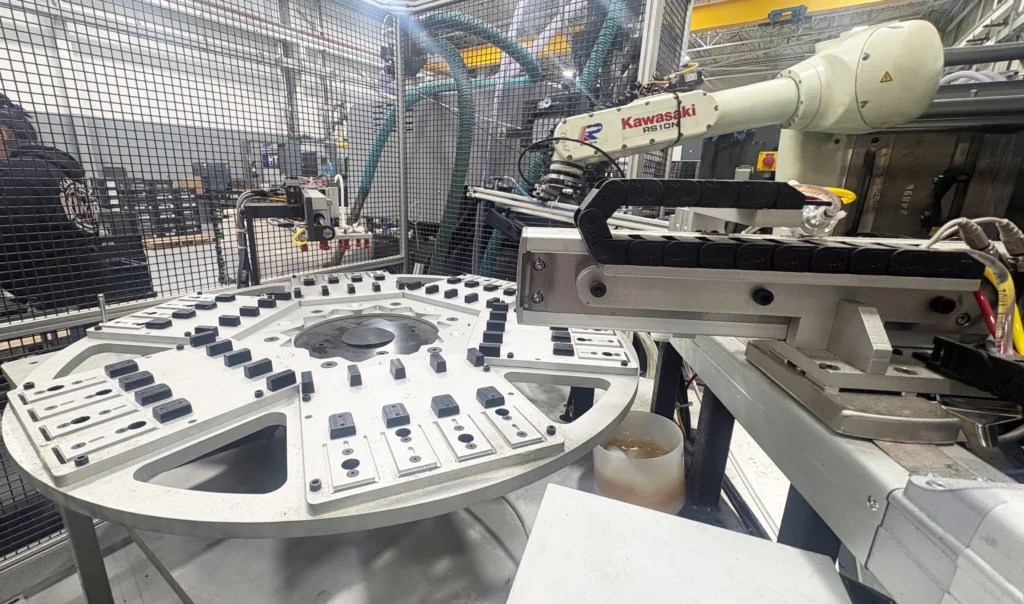
Champion automated the adhesive promoter application step of part production with an existing robot and three more pieces of equipment. “The project required three operators to apply the adhesive promoter and three more operators to apply the tape,” said Ignatowski. “We consulted with our automation supplier and determined that we could save labor costs by automating with our Kawasaki six-axis robot, Yamaha three-axis robots and a custom-built rotary indexing system. The entire automation layout was developed
with CAD.”
The six-axis robot removes the parts from the mold and places them on station one of the rotating indexing system. The rotary table indexes to a small three-axis robot equipped with an application head and a pump system that applies the adhesive promoter. “There are several additional stations in the rotation system that are simply used for drying time,” Ignatowski explained. “The last station has another small three-axis robot that picks up the parts and drops them onto a conveyor.”
Through the process of designing, testing, implementing and using the system, Champion encountered very few glitches. “We determined that only specific hose material would work, and that we had to include check valves,” said Ignatowski. The new equipment requires only minimal maintenance. “We did discover that the hoses need to be periodically replaced as they get ‘artery buildup’ from the adhesive promoter. We replace the applicator tips on that equipment daily.”
The implementation of this automation eliminated the need for three operators on a demanding, messy task and yielded a rapid return on investment. “The $93,000 automation investment yielded $100,000 annual savings in the first year,” Ignatowski said. “For this estimated five-year production run, the savings will be $500,000.” The company plans to automate the final step in the process – applying tape to the automotive part. “Our customer currently is working on a design change to the part, which will require new fixtures,” he said. “We will implement the tape application automation during this change.”
Ignatowski described why this kind of automation is important to the company. “Champion strategically has a very high automation, low overhead, lean structure,” he said. “These levels of automation allow us to keep our labor lean and achieve our strategic goals.” Ignatowski sees technology like robotics and indexing systems as add-ons rather than replacements for workers. “The robots will never replace humans where true dexterity is required,” he said, “but they do take over daunting and monotonous tasks, and this allows companies like Champion to flourish on a global scale.”
Crescent Industries
Crescent Industries, New Freedom, Pennsylvania, supplies custom molds and injection-molded plastics products for medical, industrial OEM and defense applications. It offers plastics injection mold design, tooling, custom injection molding, kitting and assembly, quality and injection molding automation. Joe Nugent, senior automation specialist, shared details of Crescent’s work cell automation project.
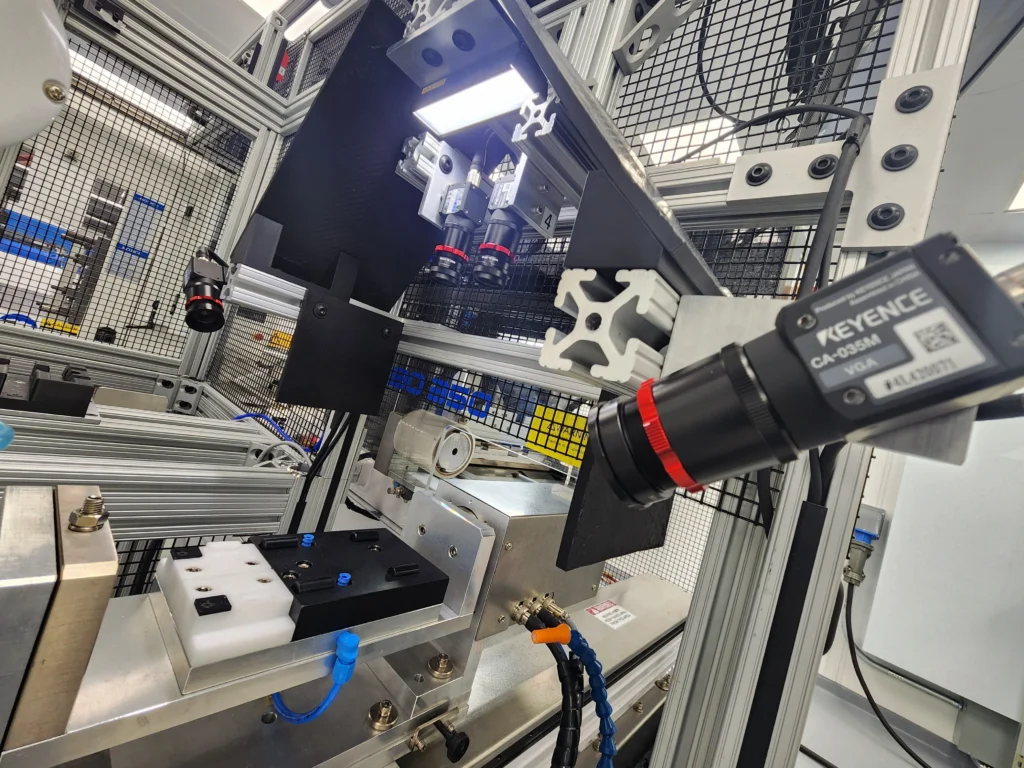
Crescent implemented an in-house-designed automated cell that performs molding, degating, pad printing, four-camera vision inspection, drying and final inspection on a complex, multi-step medical component. A Yushin press robot with custom end-of-arm tooling removes molded parts and places the parts into fixtures to trim runners. A Denso six-axis robot positions components in another fixture for pad printing and then sends the parts past a Keyence four-camera vision system to inspect print quality. The robot moves good parts to a conveyor belt to pass through a heat tunnel and into a final inspection station, while rejects are automatically diverted for recycling. With this cell, parts are handled by an operator only once at the final packing stage.
Nugent described the impetus for the automation project. “This project was born from a critical need to develop a custom automated solution for our client,” he said. “By automating the core manufacturing process, we addressed the client’s primary quality concerns while also reaching the cost-reduction targets. At Crescent, we believe the best solutions are not over-engineered. We start with the simplest functional approach and build out from there, ensuring that every addition adds real value.”
In designing this cell, Nugent drew from prior automation successes. “Leveraging years of experience at Crescent,” he explained, “we took proven individual processes from previous projects and married them into one powerful new automated workflow. By using every tool from CAD design and milling to robotics programming, and collaborating with our equipment vendors, we turned a complex integration challenge into a streamlined success.”
The work cell was designed to be as robust as possible. “We chose the hardware with one goal in mind: long-term reliability,” said Nugent. “After dealing with the initial
set-up bugs, the maintenance costs for this cell have remained remarkably low, and the system continues to perform extremely well.” The system’s consumable parts were designed to be the fastest and easiest parts to replace.
Nugent described a lesson learned through designing, testing, implementing and using this automated cell: “The primary lesson learned from this project was the value of simplicity, even under pressure,” he said. “By prioritizing a streamlined process and ensuring that components easily are replaceable, we have created a blueprint for
long-term success.”
Crescent gauged success from a big-picture perspective. “The true measure of this project’s success,” said Nugent, “was that every component performed as intended from the start. While redesigns often are a standard part of the development cycle, our commitment to simplicity allowed us to avoid costly pivots. By focusing on incremental, proven steps rather than big ‘leaps of faith,’ we ensured the project came in on time and on budget.”
Looking forward, Nugent and his department have a full slate of new automation projects. “Our team has ambitious plans,” he said. “I am energized by the roadmap we are charting. I have total confidence in this talented team, and I cannot wait to share the groundbreaking solutions that we will next deliver.”
Nugent commented on how automation of nearly every aspect of production is impacting plastics processing and its workforce. “People always will have a vital place in the industry,” he said. “We simply are redirecting human talent toward its highest and best use. While machines and robots dominate repetitive tasks, they cannot match the human capacity for creativity and rapid adaptation. By harmonizing the strengths of both, we are building a more efficient and incredibly bright future for manufacturing.”
Viking Plastics
Viking Plastics, Corry, Pennsylvania, designs and produces custom injection molded solutions for the automotive, HVAC and industrial markets. It offers molding, assembly, automation, tooling, metal-to-plastics conversion, welding, testing, program management and decoration. Shawn Gross, Viking’s president/CEO, explained the company’s 24/7 lights-out innovations using robotic part removal, automated packaging, automatic material feeding and real-time monitoring to run with minimal human intervention.
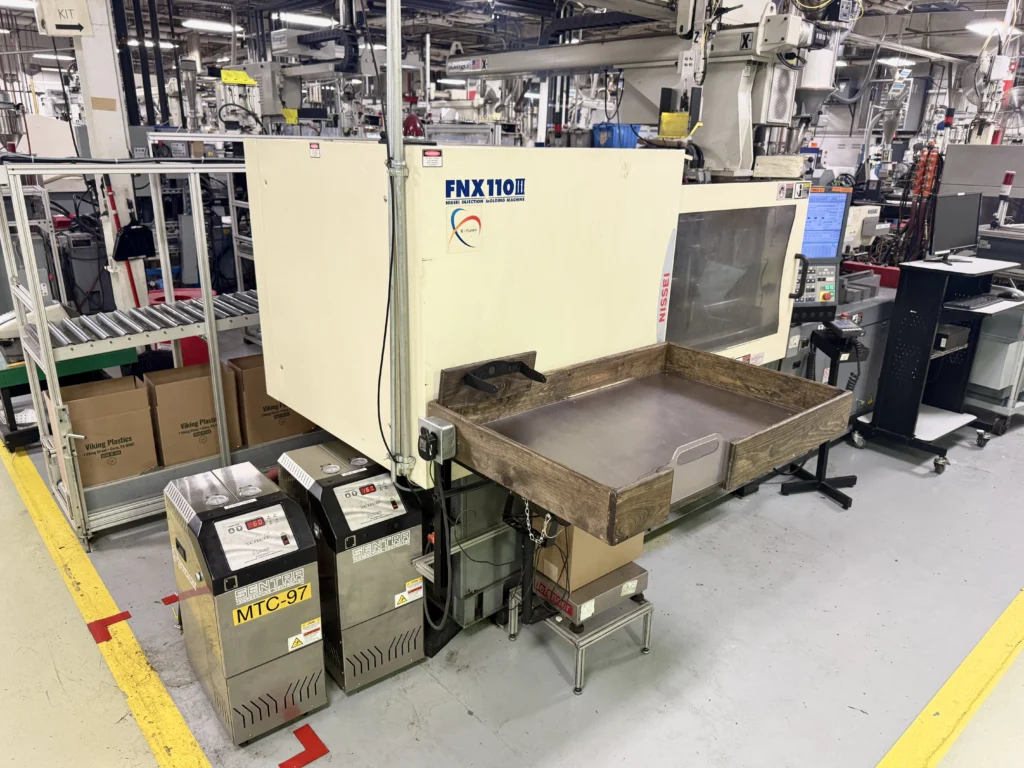
Viking has been working to establish lights-out production, where operations occur without anyone present in the company’s plants. “To achieve this,” said Gross, “we are integrating various supplier technologies and building reliable production cells that can operate independently of human interaction for eight to 12-plus hours. This initiative utilizes technologies that already are present in our plants, such as Nissei and Haitian molding machines, Ranger robots, HFA auto boxers and an IQMS ERP system, coupled with off-the-shelf technologies like cameras and sensors.”
“A big, hairy, audacious goal (BHAG)” is how Gross described the company’s initial foray into lights-out production. “We had just added molding machines to our Indiana plant in 2021 and were growing,” he said. “The challenge of capturing more production without having people in the plant caught hold, and our team did a great job setting up the first cell. We built upon automation concepts already existing in the industry as a way to grow (especially in a tough labor market), a way to improve productivity (eliminate non-value-added human touches) and a way to help us flex for customer needs that pop up without disrupting the entire workforce.”
Viking started innovating in areas where equipment existed for automatically delivering materials, packing parts and advanced packaging. “We then looked at off-the-shelf technology solutions,” Gross explained, “such as cameras and water sensors to support the work cells.” Gross measures the innovations’ success with key performance indicators. “We measure parts produced and hours of lights-out production,” he said. “In addition, we look at reliability in, for example, how often an equipment issue arises that requires a call-in.” Keeping equipment in top condition is crucial in a lights-out scenario. “We schedule our lights-out and maintenance activities so that they don’t overlap. Running lights-out requires attention to the reliability of the cell and all of its supports (air, water, material, packaging, equipment) so that nuisance downtime is not incurred.”
Gross commented on the need to be patient and to have sound assumptions about innovation projects. “Our process initiated where there was passion to prove we could do it,” he said. “A team that can see a vision of success will advance, but this can take some time because of the pre-existing culture that may exist among a plant’s workforce. In addition, it is important to have reasonable expectations while working through areas of weakness in systems and implementing ways to improve them.”
The upside of automation, said Gross, holds multiple advantages. “There is the tangible benefit of reducing labor costs,” he said, “but I think a bigger benefit comes in helping our workers see that it is possible to change how we approach our work cells. This impacts Viking as we look at future work cells, new business opportunities and how we can think and operate differently. The ongoing challenge with finding workers means we cannot assume we’ll ‘just add another operator’ to accomplish additional tasks.”
Viking will continue to look at the next press and/or part to improve with a lights-out mentality. “We are very open about using people for their minds and using robots to do the things that humans shouldn’t be doing,” Gross said. “We want to automate where we have repetitive tasks and strenuous worker movement that doesn’t add value.” Gross noted, however, that his company’s lights-out strategy is not unique. “There are many great companies that set up plants to operate with minimal to no human intervention for long periods of time,” he said. “While we don’t have the luxury of having our three plants designed that way, we have a talented team that understands the importance of using the tools we have to enhance our productivity
and competitiveness.”
Conclusion
While the approaches vary – from Champion Plastics’ single‑process labor reduction to Crescent Industries’ fully integrated medical work cell and Viking Plastics’ pursuit of sustained lights‑out production – a common theme emerges: successful automation starts with clear objectives, disciplined design and a commitment to reliability and simplicity. As labor constraints persist and customer expectations rise, the experiences of these three processors illustrate how thoughtful automation can strengthen competitiveness and position manufacturers for long‑term growth.
More information: www.championplastics.net, www.crescentind.com and www.vikingplastics.com